Note: The Oxford Dictionary of Nursery Rhymes identifies this rhyme as first appearing in print about 100 years ago, but Mother Goose herself is older than that.
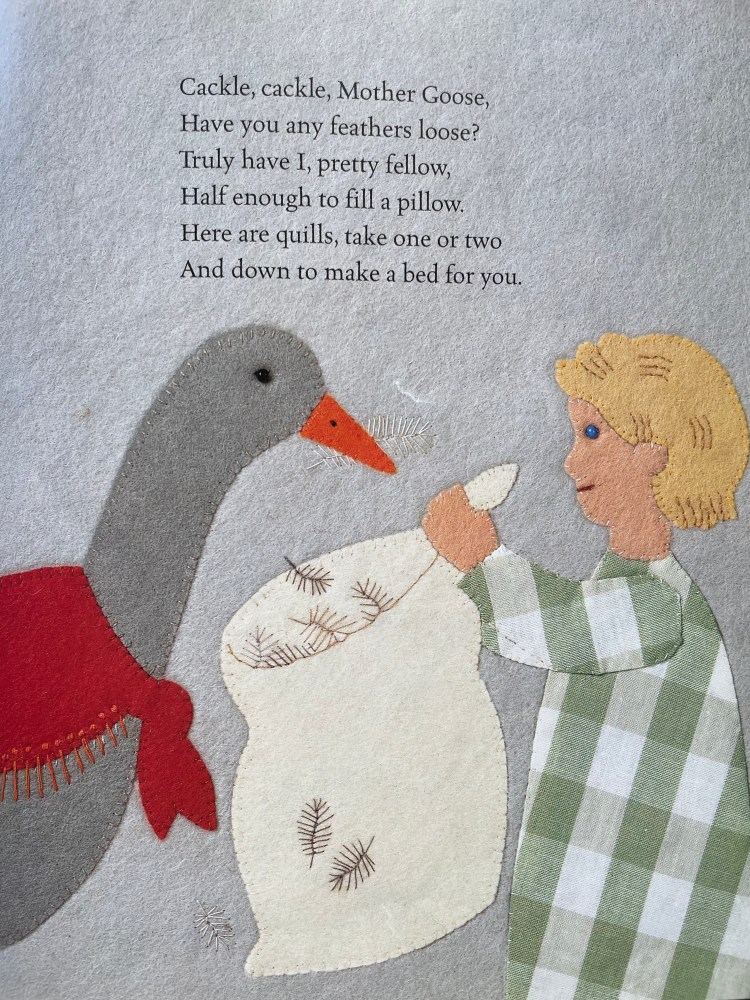
Clare Beaton‘s Mother Goose and the Pretty Fellow converse on the half-title. Mother Goose’s shawl is knotted tightly at her throat to keep it secure in flight, and has a gorgeous orange fringe. She holds a wispy airy stem-stitched feather in her beak, ready to drop it into an open pillowcase. Pretty Fellow, in his gingham nightgown (does anything say Homely Childhood more plainly?)ready for bed with his blonde head accented with comb marks made of running stitches. The figures are appliqued to the grey felt background with buttonhole stitches and oversewn.
Judicious selection of fabrics and other elements throughout the book has ensured a cohesive and pleasing collection that perfectly match the variety of rhymes. The materials used by the artist include ric rac, braid, machine-made lace, picot edging, filet crochet, bias binding and embroidered ribbon trim. These are embellished with crystalline leaves and fruit, bugle beads, and buttons, attached to the pictures by plain and fancy stitching including my favourite: couching. There’s an old-linen-cupboard authenticity to these pictures – there’s a trace of a tea spill in the tannin stained threads – that seems to match the age of the rhymes.
Fabric collage is so pleasingly tactile : Cynthia and William created a splendid Elves and the Shoemaker sometime in the 1980s that I’ve written about on my Instagram account @quiltsinkidsbooks.

In a more recent example, Kids’ Own Publishing’s artist Agum Maluach encouraged the use African fabrics with the stick figures kids made that became the book This is My Home .

The start of the new millenium brought big changes to my life. Big Bob was settled in a brand new primary school with support, and Ms May was beginning her independent reading with a wonderful teacher appropriately named Mrs Jolly.
Thanks to my own mother’s life in textiles, patchwork had been a part of my making life since late teens and was now the perfect pickup and put-down – story and song and everyday play could swirl around the table full of fabric and thread.
That was fun in itself, but it was time to go back to work. I applied for and got the job as parttime Children’s Librarian for the Nedlands Library Service. This would open the world of Western Australian libraries up to me for the next dozen years.
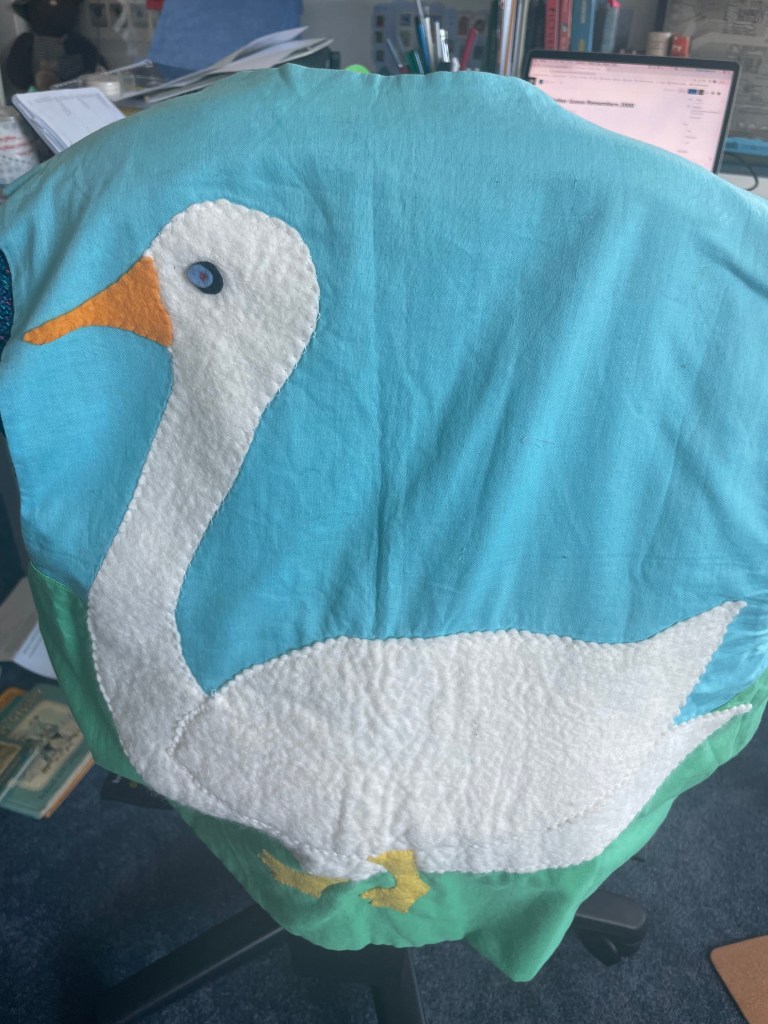
In about 1984, my textile artist Mum made me a long skirt with story characters on it to wear at Ballarat library storytimes. She used up most of her stash of white felt on Mother Goose – the three little pigs and the Owl and the Pussycat also danced on it.
I’ve never been a librarian who dressed up: contemporary Book Weeks would be torture for me. But, as they say, you cut your coat to fit the cloth and a Mother Goose vest was repurposed from the skirt for my new library job. I could always whip it off if someone suspected me of unnecessary jollity. Nursery rhymes and songs that we had sung and chanted at home became my core offerings at story programs for the next twenty years and this book was a staple.
After years of reading review journals, in this year too I began reviewing books for both Australian Book Review and Magpies. This began the next phase of my reading life.
Who’s your favourite fabric collage artist? If you don’t have one, check out Clare’s many excellent books.


 40 Years of Picture Books
Dear Margaret,
This wonderful post on Claire Beaton’s Mother Goose Remembers has not only stirred memories of this superb nursery rhyme collection but has sent me down a rabbit hole searching shelves and the internet for other picture book illustrators who have used collage, and more particularly and less common, fabric collage. A few illustrators immediately sprung to mind, Lionni, Carle and Ehlert, but they were masters of paper collage predominantly. I sought out Cloth Lullaby, The Woven Life of Louise Bourgeois, written by Amy Novesky and illustrated by Isabelle Arsenault, only to discover that Arsenault’s striking illustrations evoked the fabric that the artist returned to in her own art in later life. I’ve revisited many picture books on my shelves as well as discovered past and current picture book makers who I’m keen to learn more about. In my rabbit hole travels, I stumbled across this fascinating blog and reading list which I thought you’d enjoy https://www.bookologymagazine.com/listology/cloth-and-the-picture-book-storytelling-with-textile-techniques Now, back to my Magpies reviews…
XXXX nola
LikeLike
Loved this. Keep them coming!!!!
>
LikeLike