
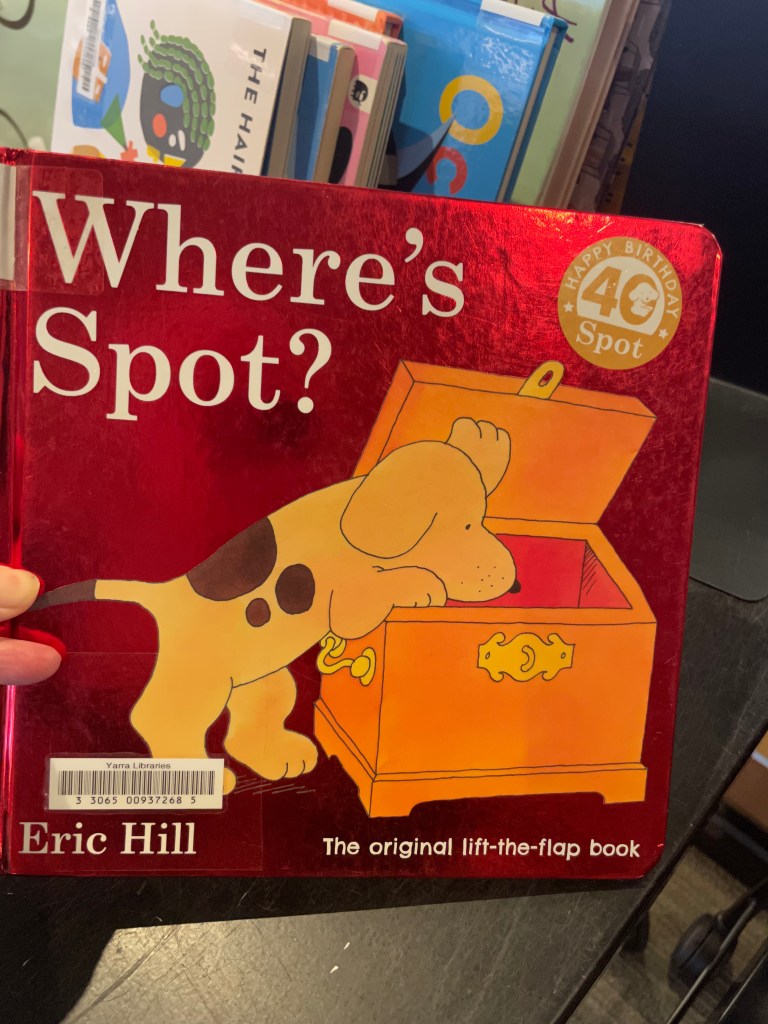
The question on the cover Where’s Spot? alerts the reader that this will be a quest. There is backstory in this first spread. Sally must be Spot’s mother – if the smacky opening sentence doesn’t give it away, we see that her bowl is the larger. She’s rolling her eyes so that we know we’re in it now; and will be with her until he’s found – she can then return to the comfy chair.
Hill’s combination of graphic design talent and the play opportunities that moveable parts provide within a narrative unite in this “first lift-the-flap book about the puppy Spot.”
Many delighted babies and toddlers have played paper peek-a-boo as the cumulative tension of Sally searching the house for her puppy builds. A menagerie of characters within the home’s likely hiding places encourage her, and the reader, to keep searching. Just when we’re certain that we’ve tracked him down, there’s one more reveal to go.

I was lured back from Brighton Library to St Kilda in early 1980, into a new decade starting with a confluence of books that affirmed and determined my professional life from then on.
I described in a previous post the entrenched library procedure at St Kilda to inspect each book as it was returned. This policy had grown from the Chief Librarian’s long life in libraries and deep distrust of library borrowers who were sure to be bent on book destruction – tearing out pictures, scribbling, or (her particular fixation) taking books to the beach and getting sand in the plastic jackets. As St Kilda was a bayside suburb, she was doomed to be continually disappointed by reader behaviour.
This distrust also informed the book selection process – any book that had interactive design, including holes, flaps and other moving parts would not even be considered for purchase. (This is the reason I didn’t know The Very Hungry Caterpillar until I went to the US eight years later.) She wasn’t wrong – the basket above shows the toll that repeated reveals by two children on one family’s copy could take – but there were concessions to be made with the developments of the new decade.
Jan Pienkowksi had won the United Kingdom’s prestigious Kate Greenaway Medal in 1979 with Haunted House, a scare-fest of pop-up art.
These were not the first books with moveable parts for children to manipulate, but the vanguard of a revival of their potential to engage and involve the reader.
In 1980, Pienkowski released Dinnertime! There are a very few books over the 40 years which I could confidently share with an audience ranging in age from nine months to 99 – but this book is one of them. The creaks and snaps of hungry jaws are literally built into the story – eat or be eaten in one of the simplest and most graphic interpretations.


“And Shark gobbled him up without saying anything at all.”
Meanwhile, a New Zealand bookseller and mother of eight published a book that became my bible.

From my lofty three years’ experience choosing and recommending books for children and families, I knew I had a lot to learn. I devoured review journals, went to talks by experienced children’s librarians, and read read read. I was plodding on with my library diploma part-time – Systems Analysis and AACRII Cataloguing weren’t exactly sustaining me, and Children’s Literature wasn’t offered until 4th year : at my current rate, that would be 1983. I’d be old by then!
Butler’s book was exactly what I had been searching for. Advice, anecdotal experience, and lists of recommended books made it very readable. I had been searching for it without knowing it was what I was looking for, and I haven’t been parted from it since.
Shirley Hughes‘s drawings for the book were a direct link between the Noel Streatfeild books of my childhood and my grownup career. I owe Dorothy Butler so much.

In simple telling through picture and words, a child’s independence within the security of parental watchfulness – which I recognised in Where’s Spot with the help of the learning that Babies Need Books gave me – will never get old.
 40 Years of Picture Books
Your memories of these books resonated with me, both professionally and personally. Pienkowski’s Dinnertime was, and still is, a guaranteed attention-grabber. At story times, I occasionally felt the need to prepare
young, sensitive readers for the surprise (shock?) at the turn of the page. Dorothy Butler’s seminal Babies Need Books also had a huge impact on me, enlightening and reaffirming, generous and eloquent. I remember seeking out, purchasing and trying recommended titles at my very first library story times, and still dip into and re-read her words to this day. As for Spot, I’m rediscovering the magic and mystery under the flaps with my lift-the-flap obsessed almost-one grandson. Tiny fingers find a corner, lift and look, a variation on our favourite game, peek-a-boo, perhaps? Thank you for your ever-insightful reflections on children’s books and reading.
LikeLiked by 1 person