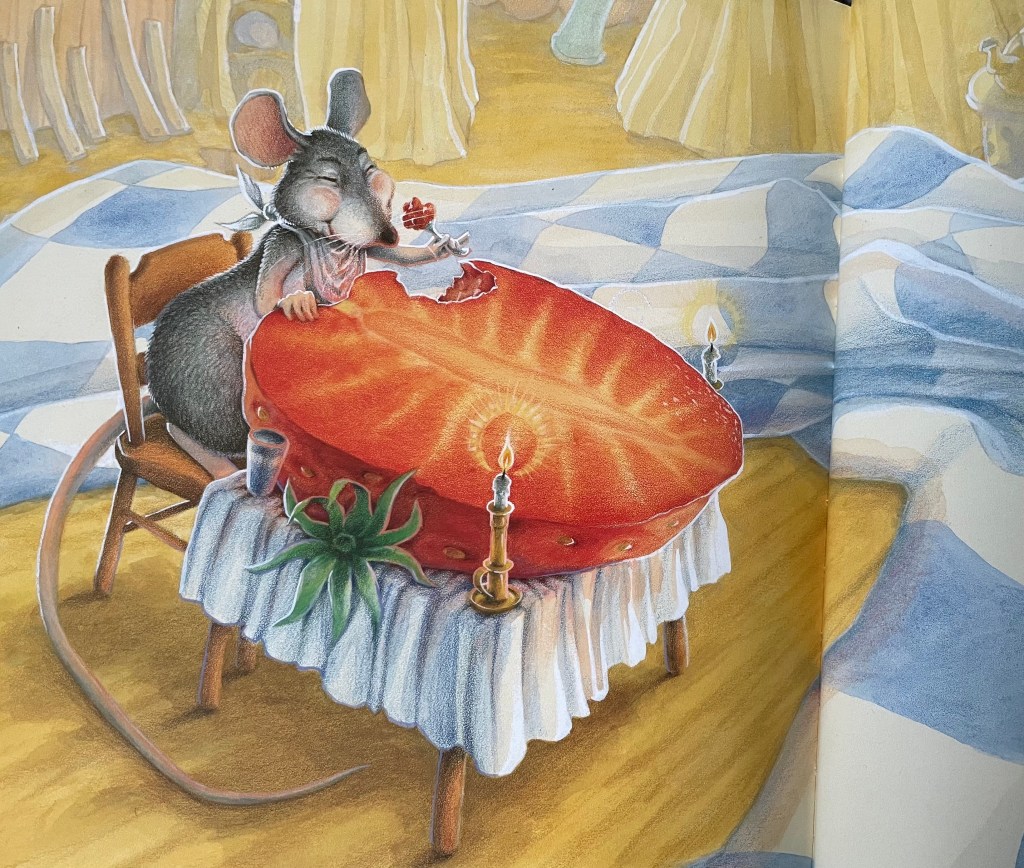
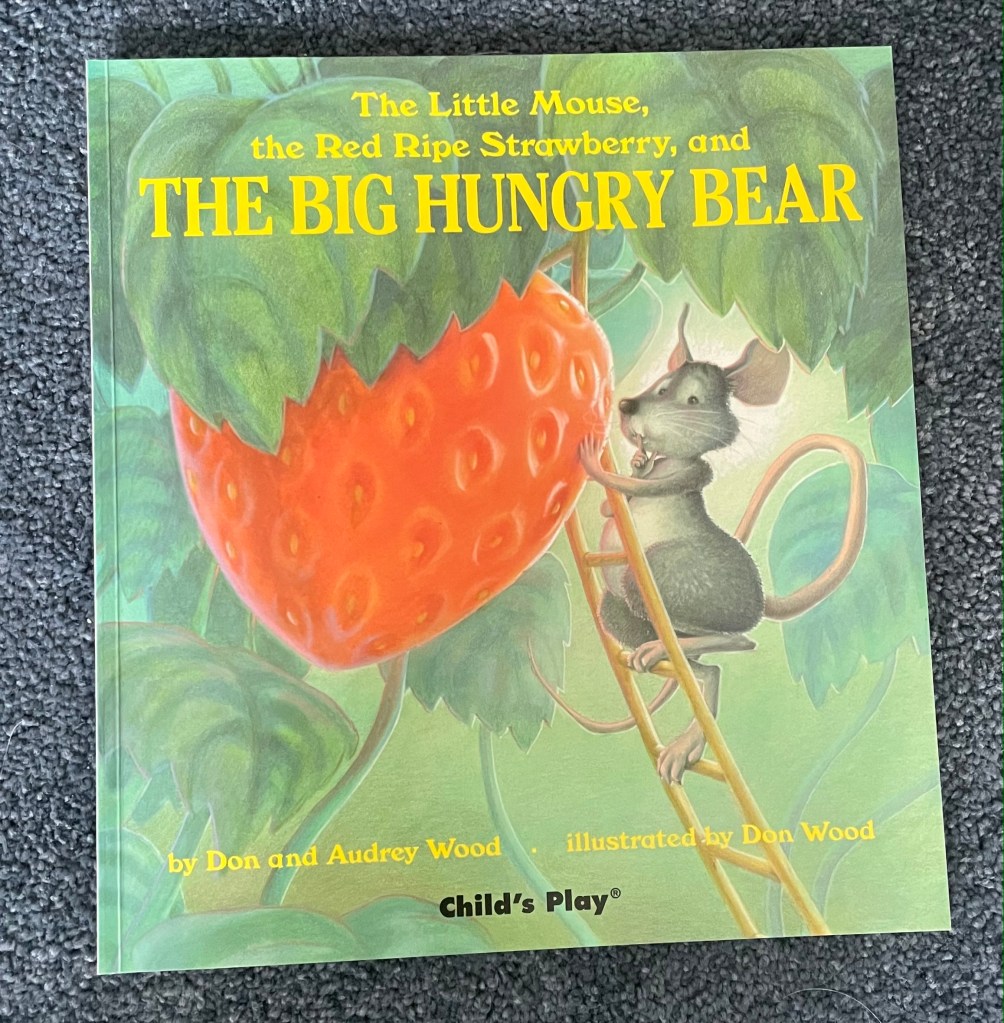
BOOM! BOOM! BOOM! The Bear will tromp through the forest on his big, hungry feet, and SNIFF! SNIFF! SNIFF! find the strawberry …
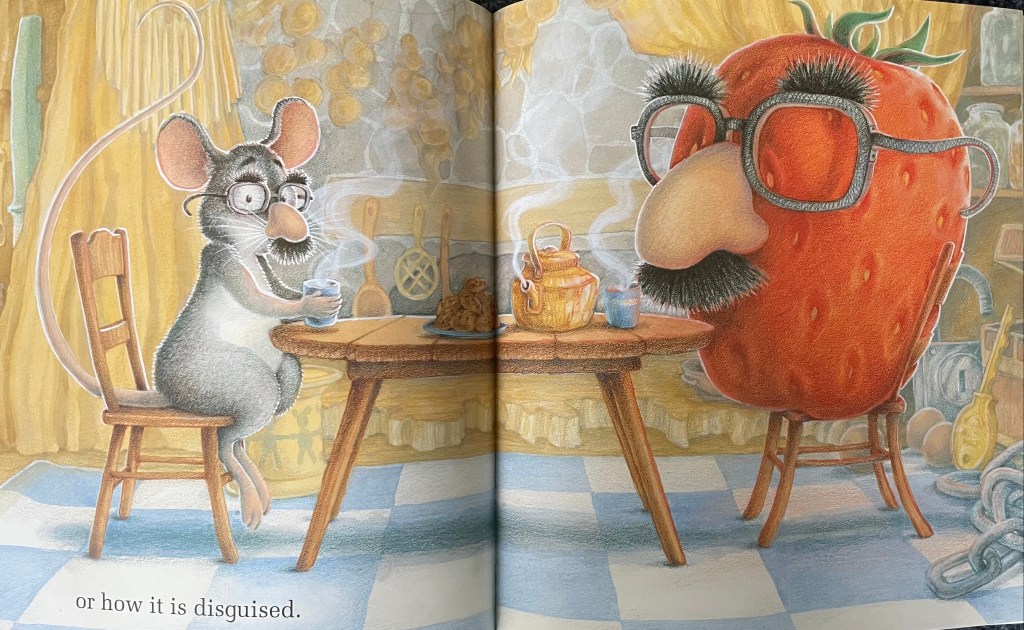
No matter where it is hidden, or who is guarding it, or how it is disguised.
Don Woods’ soft pencil drawings take the reader right into a rodent-scale environment. The lush greens of the abundant garden are both paradise and potential danger to the quivering hero, who retreats to his safe home. An unusual narration technique has the Little Mouse addressed directly by a godlike voice which warns, then guides, and ensures that LM gets what he most wants.
In 1984, I would make notes, and set aside reviews of books I wanted, as I read the library and trade journals that St Kilda subscribed to. Most were from the US and UK so there was a delay before local booksellers acquired them: they would bring in boxes and crates of books that would be left for a few days for me and the Assistant Children’s Librarian to look through and select to order from our budget. Other interested staff could browse, and talk about their favourites too. Expenditure was strictly controlled and to buy from just anyone, let alone to attend a party with a purchase order in hand, was unthinkable. I didn’t even know this book existed.
I enjoyed the freedom of this choosing, and relished regular meetings with other children’s librarians. When I’d been a student and just the Assistant librarian myself, I’d kept my mouth shut, but now I was invited up to the high table with people much more experienced and knowledgeable than me. I remember a wonderful evening where others thoroughly unpacked Raymond Briggs’ work – my ill-informed remarks and half-baked opinions were tolerated with good grace. I wish all of these superb women well, wherever they are now.
There was no local bookshop near the library but I continued to haunt The Little Bookroom in my spare time – I’ve written about the legendary Albert Ullin in a separate post on this blog. I bought this, and many other reference books for my own use, there.
Being sold through party plan must have assured its survival until a dozen years later, when my son borrowed this duo’s Twenty-Four Robbers from our local library. Having my own personal book budget, and no restrictions on parties, I soon acquired this title and The Napping House which we all loved. Share half with me is a family phrase to this day.
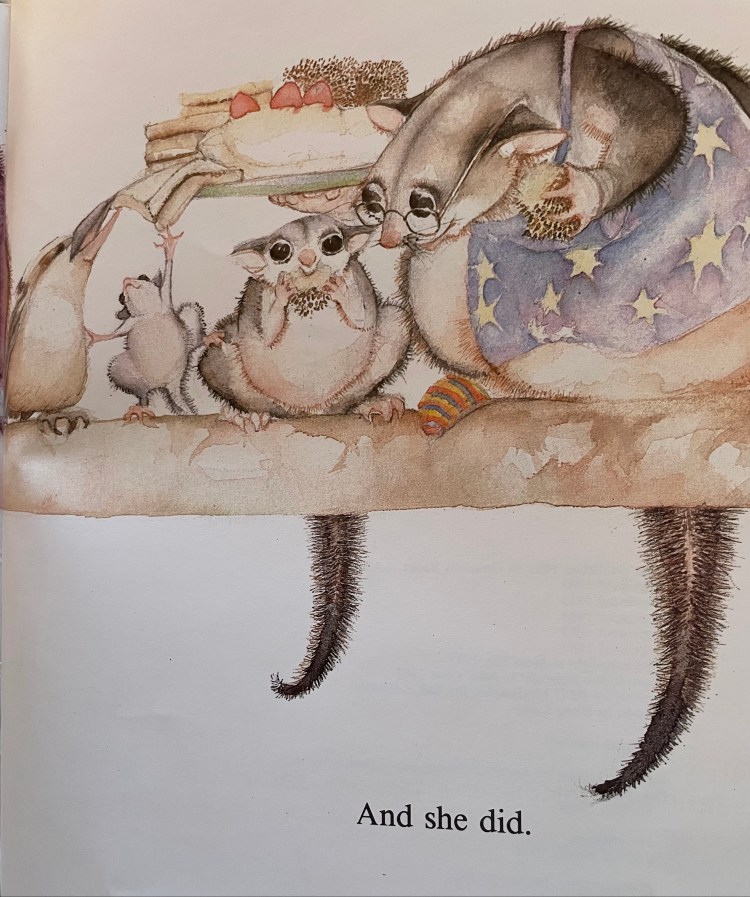
From that time onwards Hush was visible. But once a year, on her birthday, she and Grandma Poss ate a vegemite sandwich, a piece of pavlova and a half a lamington, just to make sure that Hush stayed visible forever.
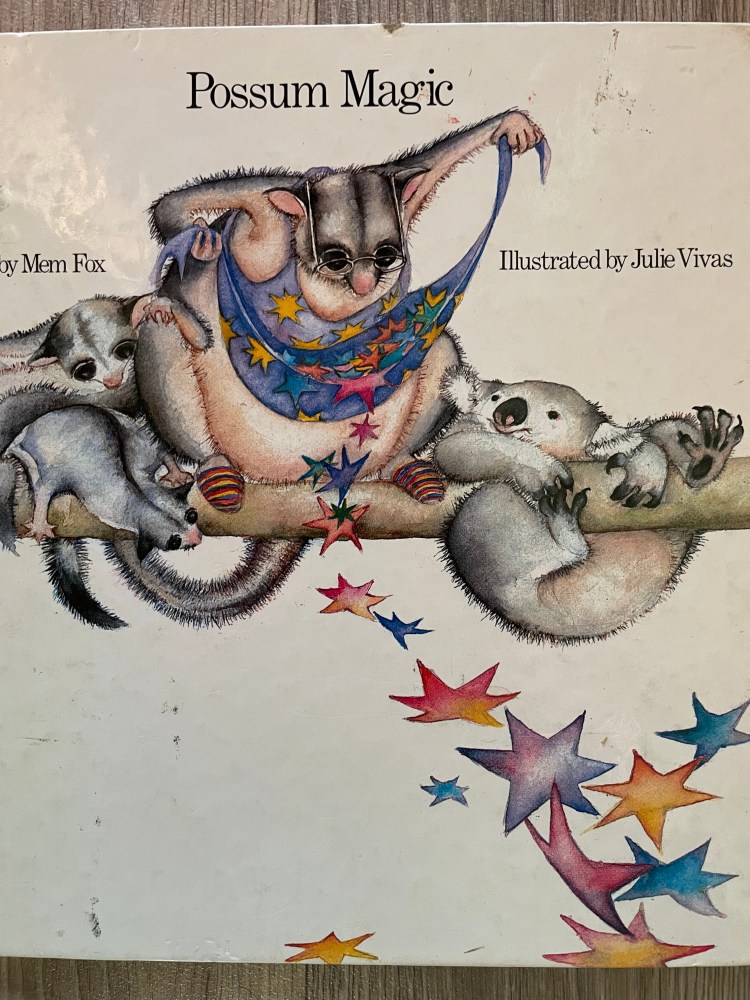
Julie Vivas’s watercoloured scenes and characters exist in white space, anchored by the horizontal lines of branches, verandah rails and a school bench. Grandma Poss performs her bush magic in a star-covered pinny and stripey slippers. Her specs are another signifier of her wisdom, even if she can’t find the spell she needs in her many books (she’s finally discarded them for this final picture.)
Hush happily makes gooey-eyed contact with the reader as she demolishes half a lamington to ensure her visibility ever after. Many suburban Australians have seen this look before, as a real live possum is surprised with the first fruit of the season in a cherished backyard tree. Grandma holds the plate with the other birthday goodies aloft and the kookaburra levers a vegemite sandwich into gulping position. In between them, a possum joey reaches up. This little unnamed character has hitched a ride from Perth to Tasmania on the last leg to be in on the feast.
Vivas’s airy line and delicate detail, with a naturalistic palette for the bush scenes, ensured this book’s international and ongoing success. Mem Fox has written about its history on her website, and the book was recently reissued in the now customary 40th birthday edition.
In 1983 I moved up from being the Assistant Children’s Librarian to the Children’s Librarian position at St Kilda Library. I had finally finished my library qualifications at RMIT : without distinction, so I was not invited to do the fourth year to convert my diploma into a degree. This meant I couldn’t formally study Children’s Literature. Poor me – back to reading everything on the trolley, instead.
Visiting local schools to promote the library and get kids excited for Children’s Book Week, I read this book aloud over and over. The format and design of this book made it perfect for sharing with a group. Teachers went ga-ga over it, and the dynamics of this experience emboldened me to be brave enough to sing a line of the text : “Here we go round the Lamington Plate” begged for it.
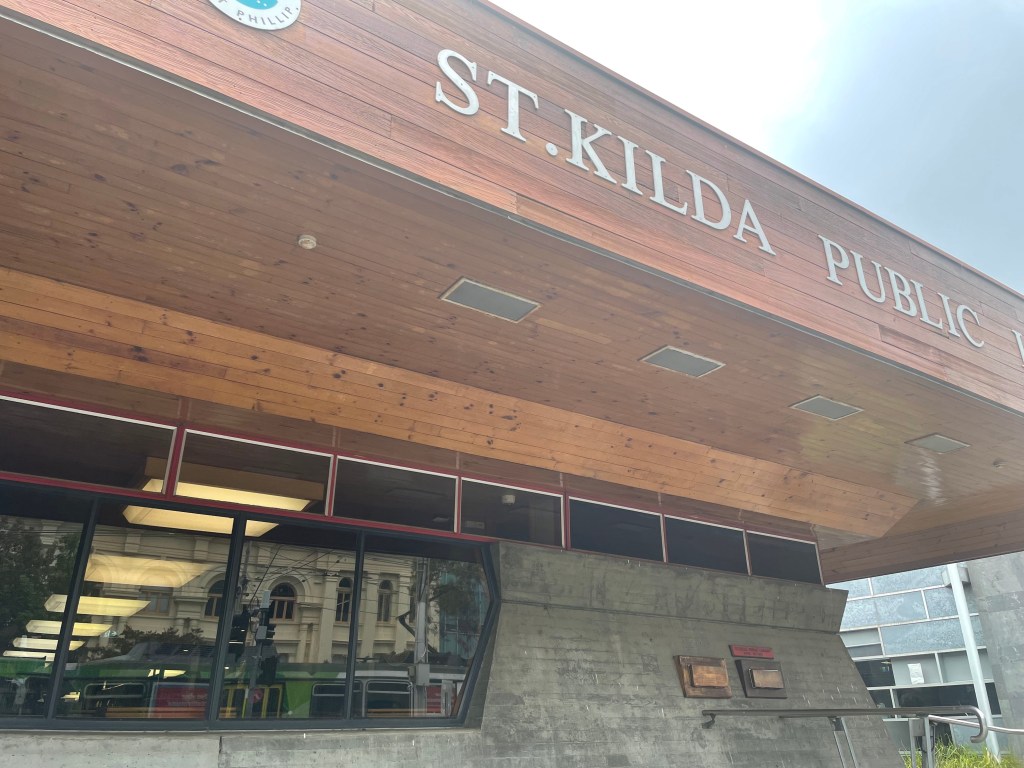
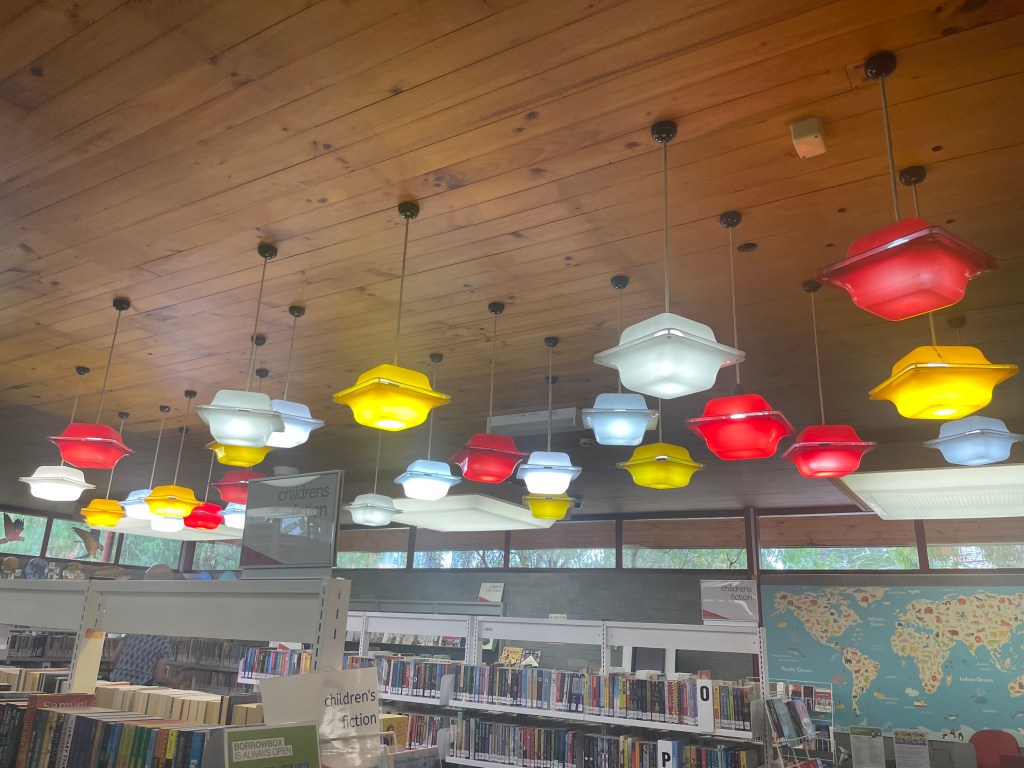
Here are some photos of the library, as it is in 2023.
The Children’s Library was at the front of the building at the time, with its distinctive lights visible from Carlisle Street. I like the reflection of the St Kilda Town Hall in this shot, and the Number 3 tram that took me home.
I found this photograph on the 50th anniversary gallery on Port Phillip Libraries’s site today.
The kids’ collection has now moved to the rear of the building but I’m so happy to see the original timber face-out shelving is still in use. On the day I visited earlier this year, I noted the copy of Marcia Brown’s Stone Soup which I remember as another storytelling favourite. Eating never fails as a theme in picture books.
Now look back at the black-and-white photo – the shelf at the bottom, near the middle ? Spooky.
I had joined the Children’s Book Council of Australia and was in the Essendon Town Hall the night that the Children’s Book of the Year awards were announced.
There was palpable disbelief among teacher and librarian members present that Pamela Allen’s Bertie and the Bear had beaten Possum Magic. My friend and mentor, Margaret Aitken, was the Victorian judge that year, and she thought that she would have to hide in the toilets to escape their ire.
Maybe that’s why it would be another twenty two years before I became a judge myself.
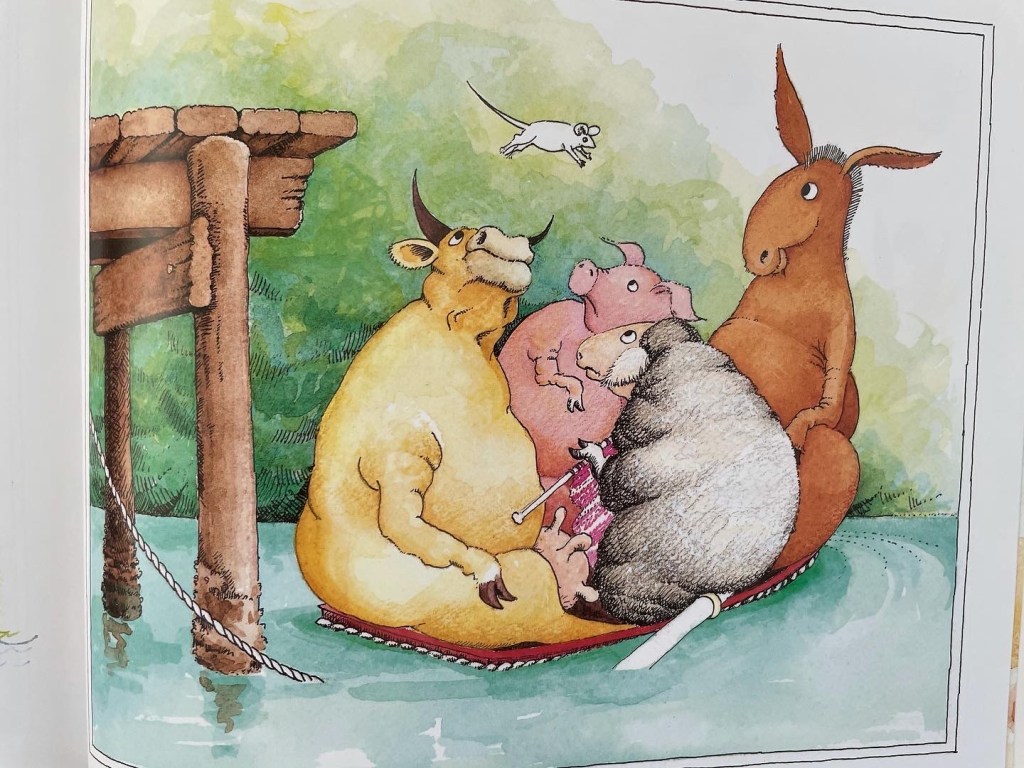
The toddler – as picture reader and listener – knows that the climax of the story is coming, and their delight in the triumph of the smallest creature will be complete. Allen has drawn all eyes on the mouse, guiding the reader to do the same. Those already afloat regard his launch from the jetty with different expressions : the sheep is doubtful she will finish her row, the cow sanguine in her splayed helplessness next to the pig’s pessimism that fat-shaming will get her the blame. Look at the eye contact between donkey and mouse. The donkey has kept up a cheerful smile, occasionally breaking into a braying laugh, throughout the action. Now she and the mouse lock eyes in their joint knowledge of the coming catastrophe.
Years after enjoying this book from birth, Ms May shared it when she was a Year 6 ‘buddy’ to children just starting school. She made them laugh by pointing to the sad soggy parade of characters on the last page – one by one -saying, “Wet, wet, wet, wet, DRY!”
Dorothy Butler wrote, in Babies Need Books:
[T]here is a definite gap, at the time of writing, in the ranks of fiction for the two-to-three year olds. Its form, certainly, is a demanding one, requiring as it does the provision of characters who come alive in situations which are believable, and action which happens – all within the experience or imagination of a human being whose knowledge of the world and its ways is only just beginning to widen.
Two years later after Butler wrote these words, this book was published by an author-illustrator who has done much to fill that gap. Who Sank the Boat? became THE perfect book for the newest library trend: Preschool Storytimes. Previously, the only library programming was during the school holidays – craft activities; showing films; and puppet shows. With great trepidation, I began weekly storytimes for under fives and their parents and carers.
The book opens with an aerial view of Mr Peffer’s place, unmistakeable as an Antipodean beach house. The text in verse is the perfect length and rhythm for the intended audience and had that essential element – a question that a small person could answer with supreme confidence after the first reading. The tension of the cumulative action though always leaves room for a shred of doubt. Maybe it was the cow.
Allen’s sensitivity to how a small child learns to read pictures is on full display here. The left hand page with text and action in miniature – sometimes in sepia crosshatched sketch – leading to the full colour right hand page to be pored over. Her earlier book, Mr Archimedes’ Bath employed similar themes of water displacement with the same device.
‘An instantaneous visual and verbal delight’ was the verdict of all seven judges of the Children’s Book Council of Australia when awarding Picture Book of the Year award to Who Sank the Boat in 1983 – the first of many accolades for her work, including the Margaret Mahy medal in 2004.
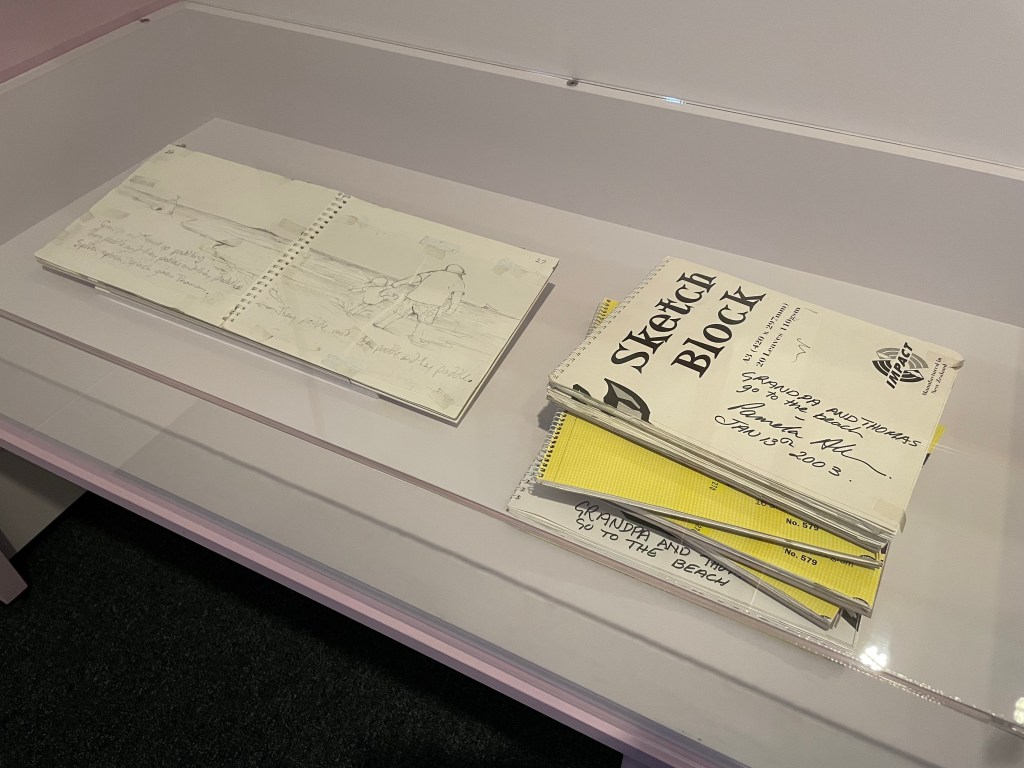
Allen recently gifted her sketchbooks, roughs and finished work to the State Library of New South Wales, where they are currently (literally) showcased as part of the Imagine… the Wonder of Picture Books exhibition until July 2023.
Portions of this blog were previously published in an article in Magpies magazine.
The blurb says: Everybody gets up sometime in the morning. This is the story of one small girl who one day woke up rather earlier than anyone else.
Artist Jan Ormerod constructed in her silent picturebook a layout of panels, differing in sizes and orientation, to show increments of time as actions. The page above is an example of how this invites the reader to tell the story. Small Girl is on the move, seen in profile, as many picturebook characters are read. The slender centre panel simulates the crack of a door that she is peeping through at the scene on the right but it’s much more than that. She is inviting the reader to venture in with her, assuring us that the story will continue to be told from her point of view, even with these new actors.
In their book Children’s Picturebooks: the art of visual storytelling, Martin Salisbury and Morag Styles assert that wordless picturebooks require assiduous observation to understand what is happening and to get all of the jokes. Ormerod hints in these panels that reading plays a vital part of this family’s routine, and will almost disrupt it.
This book, Ormerod’s first, won the Children’s Book Council of Australia’s Picture Book of the Year, when there was no distinction between older and younger readers. In this year, too, Molly Bang’s wordless book The Gray Lady and the Strawberry Snatcher was designated an Honor Book in the Caldecott awards.
I’d love to say that I knew how to share this book with children, at the time. But I was still in the phase where all I knew about reading to a group was to hold it up and open, level with my shoulder, facing the kids. Which I did: craning my neck to look at the pictures, lamely narrating, turning the pages unsmoothly, and trying not to notice how much they weren’t enjoying it.
I know better now, almost too late, observing Miss May and Big Bob at work on them, and thanks to IBBY.
Reading The Horn Book, Wilson Library Bulletin and other American library journals for years, devouring Helene Hanff’s Apple of My Eye and the only column in the What’s On columns in The New Yorker all primed me for annual leave. Most of my friends were saving for Kontiki trips to Europe, or had gone to England, on their holidays, but I was determined to go to the Big Apple and in November of this year, I did..
I stayed in a hotel that had fallen on hard times; tried to avoid libraries; and spent too long in attractions that I thought I ought to enjoy. But I also accidentally found the Fourth Avenue secondhand bookstores recently eulogised in documentaries, and spent whole days sitting and reading in them. I discovered the delectable Museum of the City of New York and the waiter at the diner around the corner from my accommodation knew how I liked my eggs without asking after a few days. A wonderful month.
I returned to St Kilda (in time for the school holiday program) determined to go again, for a longer stay, and to read more before I did.
In 1988, I would. But in the meantime, there was a library qualification to finish, new illustrators to admire, and just plain work to be done. Like Small Girl’s mum, I was often running late.
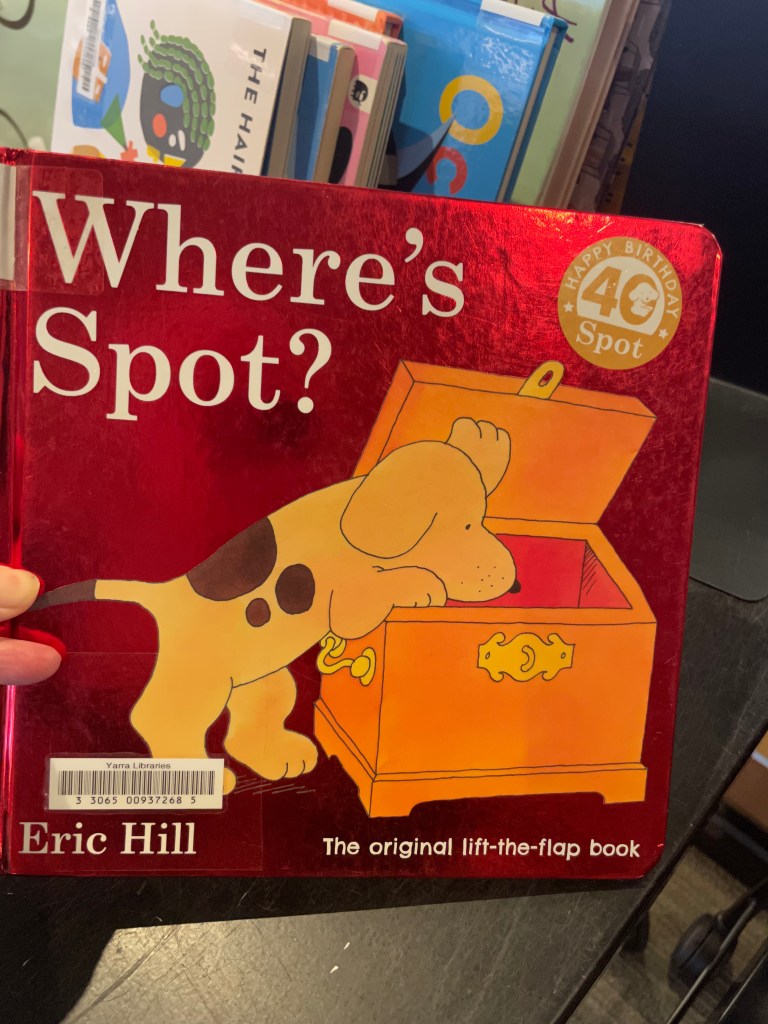
The question on the cover Where’s Spot? alerts the reader that this will be a quest. There is backstory in this first spread. Sally must be Spot’s mother – if the smacky opening sentence doesn’t give it away, we see that her bowl is the larger. She’s rolling her eyes so that we know we’re in it now; and will be with her until he’s found – she can then return to the comfy chair.
Hill’s combination of graphic design talent and the play opportunities that moveable parts provide within a narrative unite in this “first lift-the-flap book about the puppy Spot.”
Many delighted babies and toddlers have played paper peek-a-boo as the cumulative tension of Sally searching the house for her puppy builds. A menagerie of characters within the home’s likely hiding places encourage her, and the reader, to keep searching. Just when we’re certain that we’ve tracked him down, there’s one more reveal to go.
I was lured back from Brighton Library to St Kilda in early 1980, into a new decade starting with a confluence of books that affirmed and determined my professional life from then on.
I described in a previous post the entrenched library procedure at St Kilda to inspect each book as it was returned. This policy had grown from the Chief Librarian’s long life in libraries and deep distrust of library borrowers who were sure to be bent on book destruction – tearing out pictures, scribbling, or (her particular fixation) taking books to the beach and getting sand in the plastic jackets. As St Kilda was a bayside suburb, she was doomed to be continually disappointed by reader behaviour.
This distrust also informed the book selection process – any book that had interactive design, including holes, flaps and other moving parts would not even be considered for purchase. (This is the reason I didn’t know The Very Hungry Caterpillar until I went to the US eight years later.) She wasn’t wrong – the basket above shows the toll that repeated reveals by two children on one family’s copy could take – but there were concessions to be made with the developments of the new decade.
These were not the first books with moveable parts for children to manipulate, but the vanguard of a revival of their potential to engage and involve the reader.
In 1980, Pienkowski released Dinnertime! There are a very few books over the 40 years which I could confidently share with an audience ranging in age from nine months to 99 – but this book is one of them. The creaks and snaps of hungry jaws are literally built into the story – eat or be eaten in one of the simplest and most graphic interpretations.
“And Shark gobbled him up without saying anything at all.”
Meanwhile, a New Zealand bookseller and mother of eight published a book that became my bible.
From my lofty three years’ experience choosing and recommending books for children and families, I knew I had a lot to learn. I devoured review journals, went to talks by experienced children’s librarians, and read read read. I was plodding on with my library diploma part-time – Systems Analysis and AACRII Cataloguing weren’t exactly sustaining me, and Children’s Literature wasn’t offered until 4th year : at my current rate, that would be 1983. I’d be old by then!
Butler’s book was exactly what I had been searching for. Advice, anecdotal experience, and lists of recommended books made it very readable. I had been searching for it without knowing it was what I was looking for, and I haven’t been parted from it since.
Shirley Hughes‘s drawings for the book were a direct link between the Noel Streatfeild books of my childhood and my grownup career. I owe Dorothy Butler so much.
In simple telling through picture and words, a child’s independence within the security of parental watchfulness – which I recognised in Where’s Spot with the help of the learning that Babies Need Books gave me – will never get old.
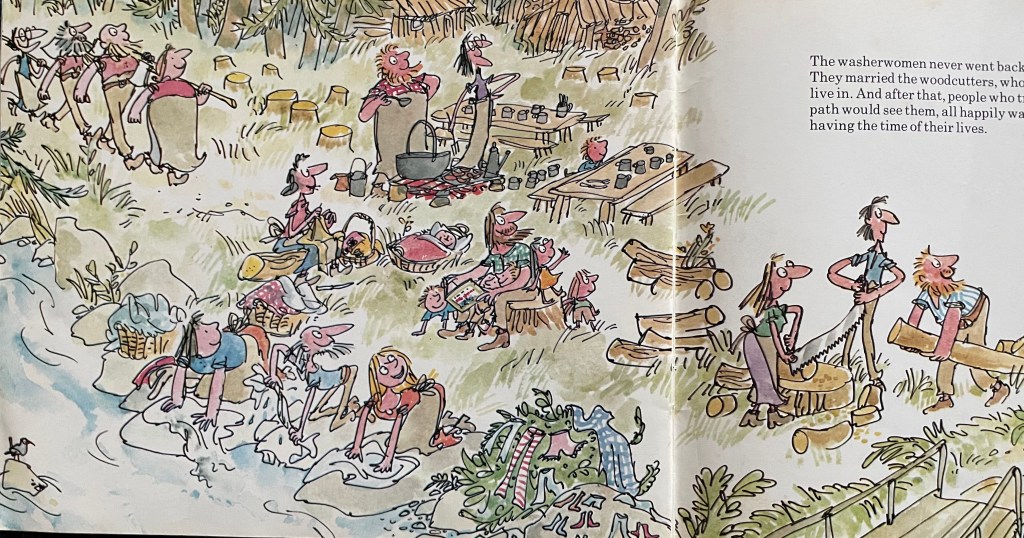
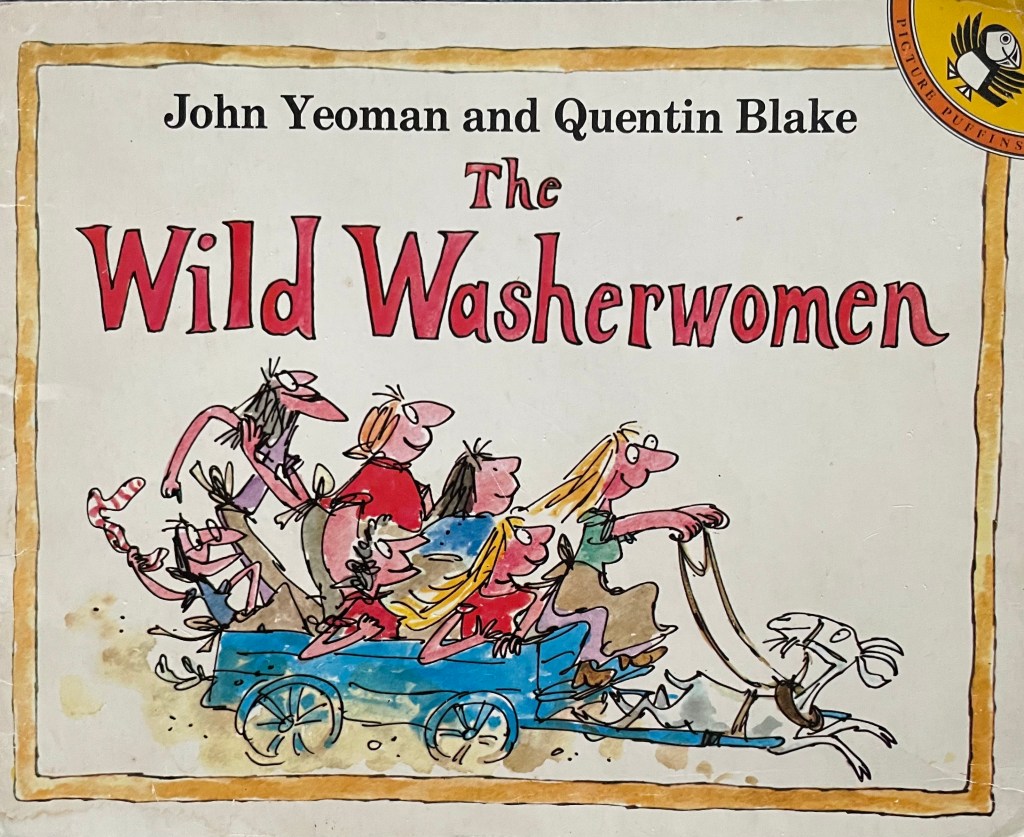
‘The washerwomen never went back to work for Mr Balthazar Tight. They married the woodcutters, who built them some new log huts to live in. and after that, people who travelled along the mountain path would see them, all happily washing and woodcutting and having the time of their lives.’
Blake describes John Yeoman, who wrote this book, as ‘my oldest friend and collaborator.’ Yeoman’s texts, folk-inspired tales, were the perfect set up for Blake’s flights of imagination as they were published throughout the 1970s. The complete harmony of the happy unions that resulted from the washerwomen’s rampage is in this delightful doublespread.
One of my childhood reading fetishes was trying to decipher what was on a cover that a character was holding: in this example, the woodcutter’s audience are enjoying the book they’re pictured in.
When I looked at the Brighton library’s copy of Roald Dahl’s Charlie and the Chocolate Factory during this year, the illustrations were by Faith Jaques – their collaboration began with The Enormous Crocodile in 1978. Blake also worked with another author I love, Russell Hoban, during this period.
His delectable solo creation, Mister Magnolia, would be published in 1980.
I had left my job at St Kilda, and Melbourne, and moved interstate for Love. Alas, he was not the woodcutter of my dreams, so I returned. I worked in a tertiary college library for long enough to start detesting emptying photocopy machines, and then got another children’s assistant position – at Brighton Library.
My family lived in East Brighton when I was 12 – 14, and the library had been a long walk down Bay Street. My best friend and I would walk there in the school holidays, taking our time and calling in at op shops on the way. The building is now known as Higginbotham Hall.
In the intervening years, the library had moved into the old Town Hall in Wilson Street. As with the Bay Street building, the children’s library was on the upper storey (and no, there wasn’t a lift.) Not only were there my childhood memories of the books strong – in many cases, they were the same copies I had borrowed. It was total affirmation that I was where I wanted to be.
I was so happy to be back among children and families. At St Kilda, the high turnover of rental properties combined with the area being the first place of residence for new arrivals to Australia meant that it was hard to sustain relationships with individuals. A local primary school teacher told me that at the end of a school year, she might still have only 10% of the students who had enrolled at the start. Brighton was different and I made friends with many small people. One former 8-year-old, his mum and I are still friends today.
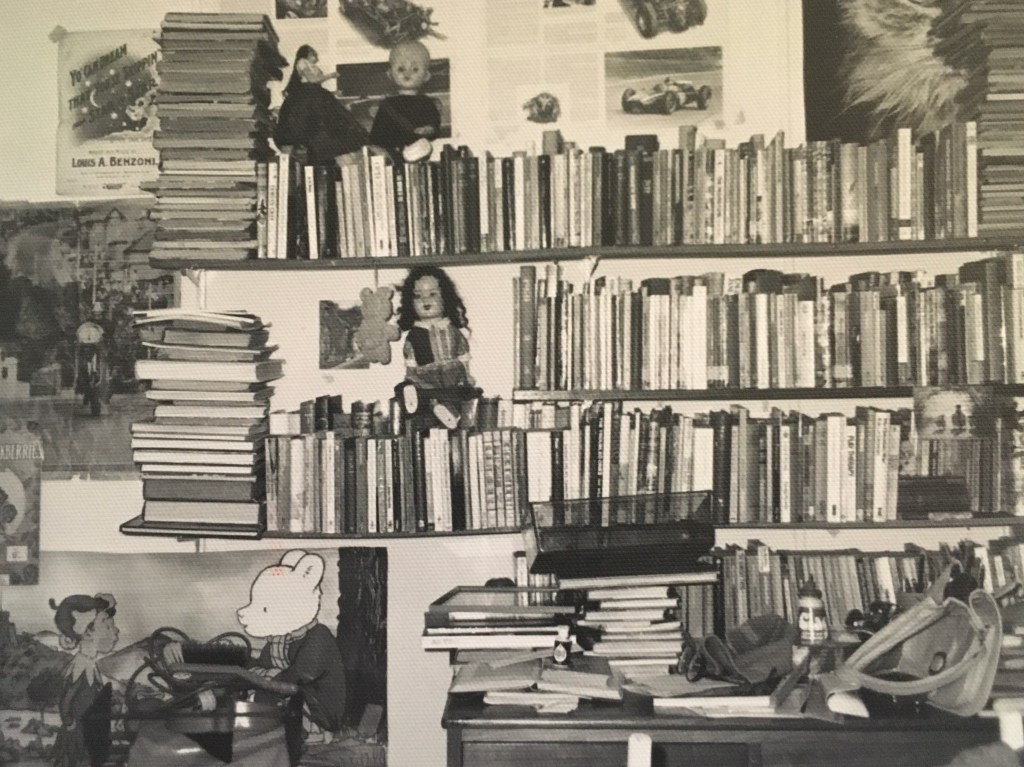
Also by this year, my personal library was extensive. Years of buying in op shops, church fetes, and new books with most of my meagre salary gave me a huge collection, most of which I meant to read someday.
Here they are, when I had returned home and moved into my dad’s workshop – they were his GP posters – and both parents avidly encouraged me to find another share house.
A new decade beckoned – with it, the beginnings of the work I was meant to do and a burst of bright publishing talent for babies and toddlers.
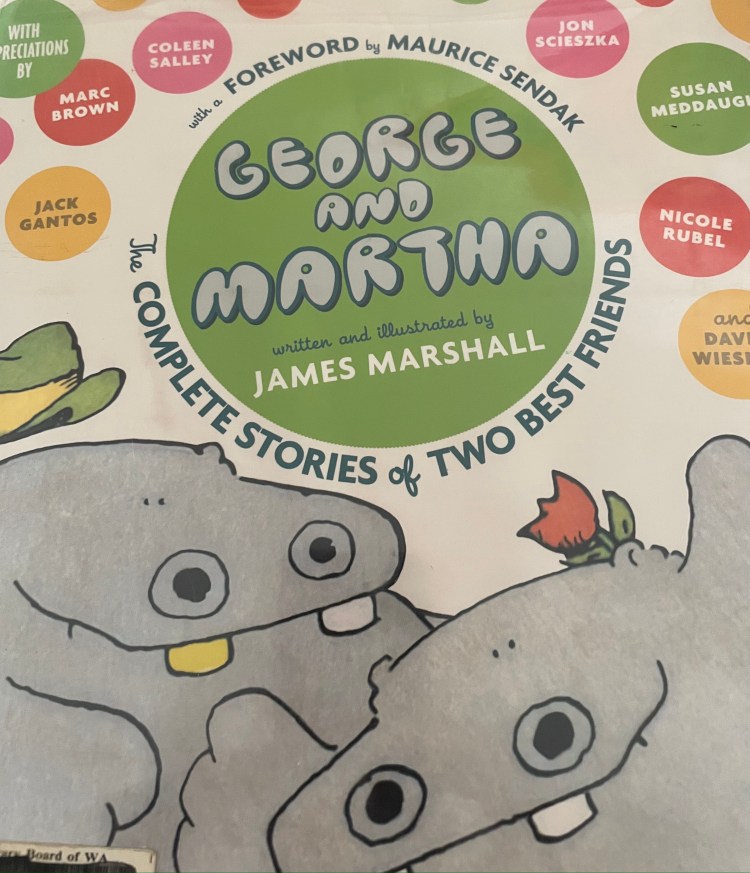
James Marshall has drawn George ministering to his friend Martha, who has foolishly spent too long in the sun. Although these animals live in suburbia there are signs that it strains to accommodate them : her pretty rose quilt sags to the floor and the doorway seems to ease upwards to let George through. A tiny flick of a pen-stroke conveys Martha’s physical pain and chagrin at not taking George’s advice in the first place. George’s twitchy upper lip is dying to tell her so. The framed motto, ever so slightly askew, is one they both live by.
The great Maurice Sendak praised Marshall : ” [His] simplicity is deceiving; there is richness of design and mastery of composition on every page… The refined sensibilities of his hippos stand in touching contrast to their obvious tonnage, and his pen line – though never forgetting their impossible weight and size – endows them with the grace and airiness of a ballerina and her cavalier.”
Sendak later executive-produced the animated series of their adventures, which became a must-see in our house at the end of the 1990s. Both my children (Big Bob and Ms May) loved the droll humour and interwoven stories voiced wonderfully by Andrea Martin and Nathan Lane. The books were then harder to find, so this volume found years later in a library discard sale was seized on as the treasure it is.
In 1978, I didn’t know that George and Martha existed.
It was my second year as an Assistant Children’s Librarian at St Kilda Public Library : a job I had finagled my way into somehow, while still studying at RMIT.
The library was still relatively new then. Despite being one of Melbourne’s oldest municipalities, St Kilda had had no free public library until the early 1970s and the Chief Librarian, Vida Horn, was instrumental in every aspect of building it from the ground up.
The children’s library had a rich collection of the very best picture books from the UK, USA and Australia, with selection of new titles informed by library and review journals from those countries too. I was trying to learn as much as I could, and to read everything as well.
Vida was very strict about all library procedures and, in particular, that library staff not seen reading while on the desk. Fortunately, it was also her policy that every single book returned to the library had to be inspected for damage. I was trained to scan the cover front and back for wear and tear, then open the book at the back cover and flip backwards through the pages, checking for signs of damage and foreign objects. Fortunately for me and my chosen specialty of 32-page books, my familiarity with artists’ styles and techniques grew wonderfully through this daily routine. If I fell in love with a book, it would then be subject to minute inspection to ensure that I didn’t miss any potential repairs (or a single word.)
I learned so much during these two years ; it seems incredible that I carelessly threw the job – and the boundless feast of journal reading – away for Love. But I did, and the consequences led me back to a childhood library. See you in 1979.
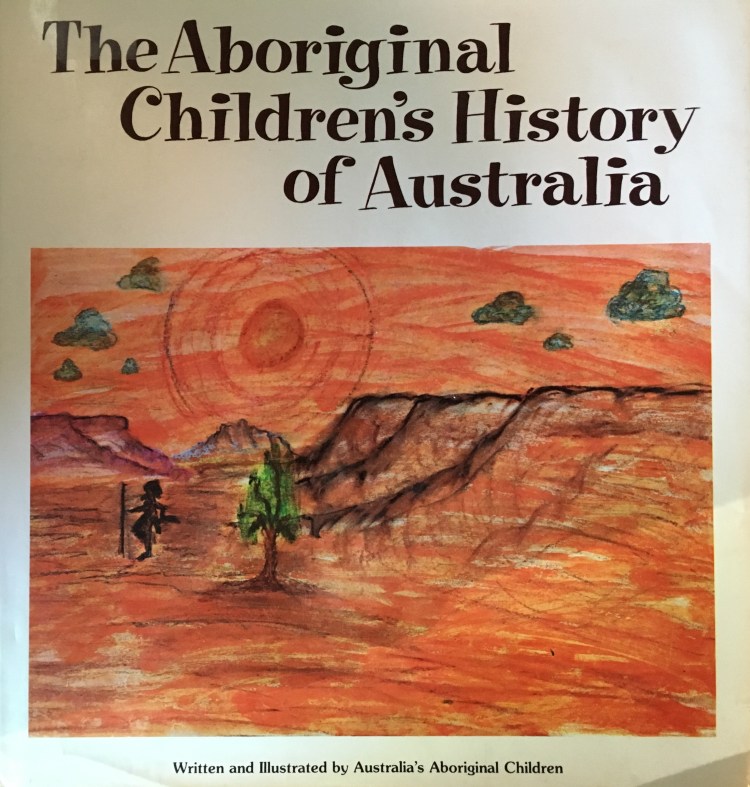
‘This is our land. It goes back, a long way back, into the Dreamtime, into the land of our Dreaming.’
In paintings, drawings in texta and pencil, children from communities all over Australia tell stories from their world in the late 1970s, and times past. The format of the book is very much that of art books of the period, and the works have a high standard of reproduction which honours the children’s work. As well as historical subjects, the young writers tell stories of their ordinary life in a way that relates universal childhood experiences.
“Yagan made friends with [the white men] but they made war…This got worse and worse until Yagan and his dad were killed.
The mother cried.”
Yagan is killed
Cultural historian Dr Mary Tomsic says, “Children’s voices, as expressed in books by children, are a significant but underutilised cultural and historical source that records children’s experiences and interpretation.”
Interactions with visitors and invaders – Captain Cook, white settlers and the Japanese during World War II – are retold in detail, as is the activism at Wave Hill. Bloody conflict and suffering are not avoided but neither are they sensationalised.
The artist of individual paintings in the book are identified by their community and state in captions. (Heartbreakingly, there is more than one labelled Artist Deceased.) It’s not always clear whether the story on the same page or spread has also been written by that child, but there is a list of the story-tellers by name at the start of the book.
In an article published by Northern Land Council on January 23 2019, Yolnu author and artist Merrkiyawuy Ganambar who was a student at Dhupuma College in Gove NT remembers :
“I think we had to do three things that was happening at that time: one was the beginning, what they call the Dreamtime stories, the story of how life happened and that’s why I drew the two sisters down on the beach, and then the next one was what’s happening now, and the last one was what would you like to see in the future?”
Merrkiyawuy’s painting of a weeping brolga is one of 346 returned to Yirrkala Arts Centre from the National Museum of Australia, which has housed the artwork for the book since 1991. Dr Ian Coates, head of the Collections Development Team at NMA is quoted in that article as saying that the museum is working on digitising and repatriating originals back to artists in their communities. With 3383 illustrations from 70 schools Australia-wide, it would be a treat to see all of them repatriated to Country.
“Through the natural simplicity of their words and paintings, they convey their enjoyment and enthusiasm for the land which has been theirs for over 40, 000 years … the story of Australia revealed in this book reflects the poetry and imagination of the children who tell it. It speaks in a language that will be understood by children and adults throughout the world”– Book jacket copy.
This book was Highly Commended in the Picture Book category for the Children’s Book Council of Australia awards in 1978. There is a television film of the project (made at the same time) called ‘Dreamtime, this time dreamtime’ – described on Trove but not available online.
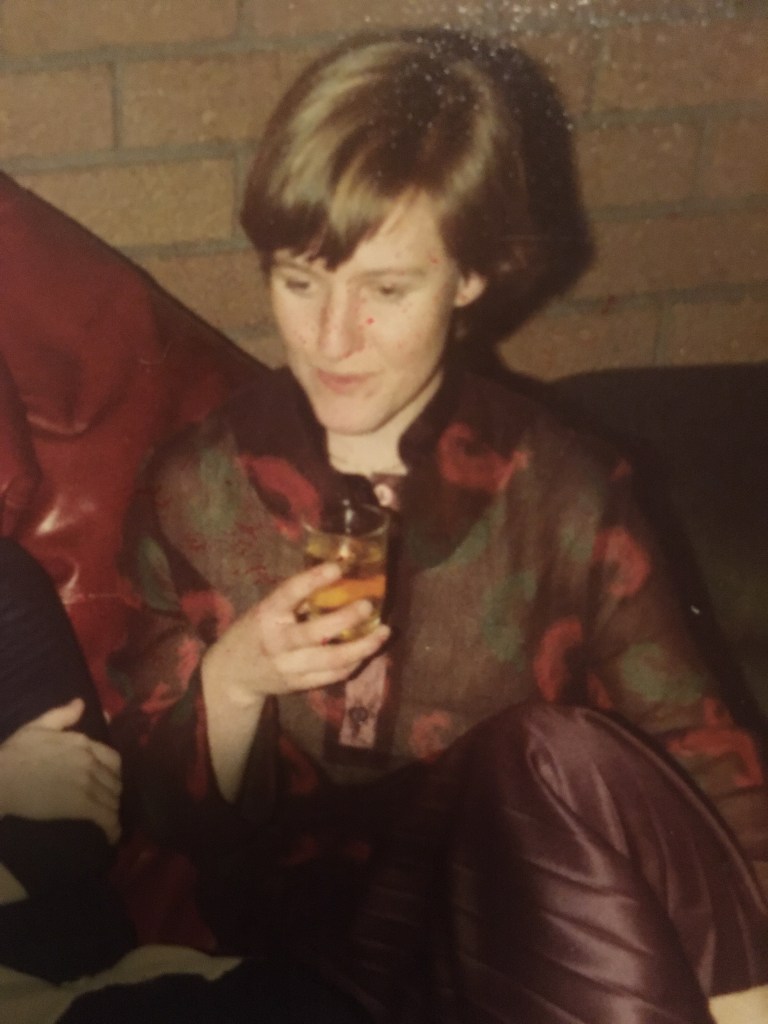
August 1977 at a party
I’d always heard from teachers and family that I was, or should be, a writer. I was published in roneo’d school magazines and wrote letters to family and penpals incessantly. I once wrote a sensational teen novel in an exercise book that was passed around all my fellow Year 8 students, and disappeared in the process.
The only career path that anyone could suggest for a writer at that time was journalism. I had made the unfortunate choice to study politics in my Higher School Certificate year (Year 12) and that meant reading The Age from cover to cover each day. Not only did this cement my determination not to be a journalist, but I’ve avoided newspapers ever since. Except for their Books and Writing pages, of course.
Up until my final year of high school, I hadn’t known that a career being a children’s librarian was a thing. I write this now with many apologies to the anonymous custodians of programs and collections that I enjoyed at Te Takeretanga o Kura-hau-pō (Levin Library), Oakleigh Public Library and others. In 1977, I lived in Moorabbin and walked regularly to the library at the end of my street to earbash the excellent Margaret Aitken about my career ambitions. I began studying librarianship at RMIT that year, applied for the position of Assistant Children’s Librarian at St Kilda Public Library and began in earnest.
The State Library of Victoria hosted regular meetings for children’s library staff and at one of these I heard Margaret Dunkle talk about this book. It was the first time (but not the last) that I left a meeting with a book recommendation , walked straight to a bookshop, and bought it.
This book convinced me of the power of children’s own stories and artwork, forty years before I met and worked with Mary Tomsic while working for Kids’ Own Publishing – 2017 blog entry to come.
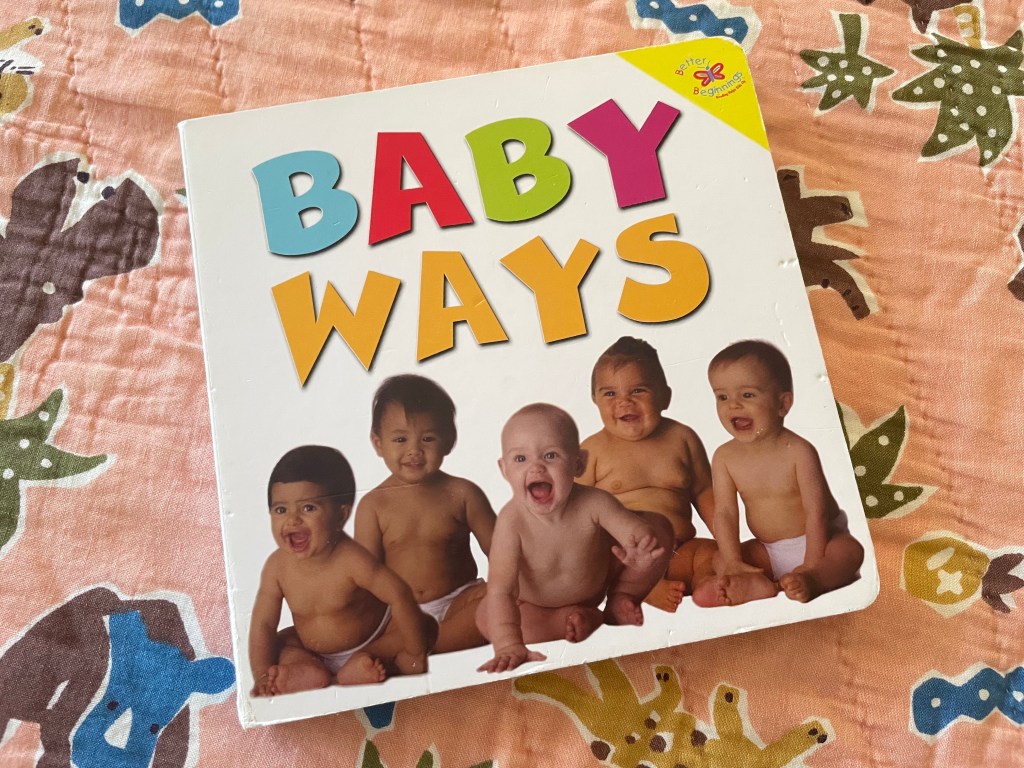
Here is a mother describing her son’s first encounter with Baby Ways, to a researcher from Edith Cowan University. I thought it was fantastic. First of all you had every colour in there, you had every size of baby in that some were a bit skinny, some were real plump. They all had happy faces. They were all doing something that was naturally a baby and they aIl looked at you…whoever did the photography was superb…the fact that my son actually sat on my lap for the whole minute and a half and just flicked through the faces, flicked through all of them and when he got to the end he just held it and giggled and laughed at himself (looking at the mirror) so I thought that was a really good first session.
When Better Beginnings Family Literacy Program was piloted in Western Australia in 2004, the first gift books for babies were chosen from the limited range imported from the US and UK at the time. It’s hard to remember when there were so few board books. While the imported books were valued by the families who received them, the diversity of WA babies was not fully represented. The gift book, like the program itself, could never be ‘one size fits all’ but there was a definite need for one title to anchor the program. With close to 30,000 babies born in the state each year, a guaranteed supply of the same title in quantity was vital. Additionally, there was very limited funding for the program in the early days of its development. Local governments were encouraged to buy into the program by nominally ‘purchasing’ the book so the more affordable this could be, the better. Nola Allen and I, as part of the foundation Better Beginnings team, set about creating a board book that would address each of these needs. Magabala Press produced Australian Babies in 2005 as the first trade title which featured photographs of Western Australian babies. Its Broome vibe is conveyed as a wordless book and we felt the definite need for some text to support parents in enjoying reading aloud from birth. Which books inspired us in thinking about what we wanted to make in a book to reach all children?
We could not get past Helen Oxenbury’s superb baby books, published in the mid 1990s. Her melon-headed baby navigates its small world in a series of domestic adventures, regarding everything seriously from a nine-to-12 month-old baby’s perspective.Whether busily eating, toddling or sitting on the potty, babies could see themselves in these books.
This firmed our resolve that we wanted a simple text which traced a baby’s daily activities. We also wanted images featuring babies the same age as the potential readership – between eight and twelve months old. Respected children’s editor from Fremantle Press, Cate Sutherland, was brought in to oversee the project and our collaborative efforts were scaffolded by her experience. It was Cate who commissioned noted WA photographer Frances Andrijich to take the babies’ pictures. She also mentored us through our rough ideas and rhyming scribbles to a brief which detailed what the babies would need to be doing in those pictures.
Where to source the babies? Partnership with Health is essential to the delivery of Better Beginnings. The excellent community child health nurse at Mirrabooka accepted the challenge of selecting fifteen babies for an action-packed photo shoot over one day. They had to be able to sit up and to do the activities we wanted pictured – eating, crawling, holding a book – and be easygoing enough to withstand being undressed to terrycloth pants and then coaxed into posing on a large table – with parental guiding hands just out of shot. On the day of the shoot at Mirrabooka Community Health Centre as the babies came in to be photographed, we asked the nurse how she had chosen them. Well, she said, I put them down on the floor. If they crawled off too quickly, they didn’t make it. The babies came in two by two throughout the day, and we could see our sparse text being expanded in new and delightful ways, following their different personalities and antics. Frances Andrijich took many wonderful photographs which we had to choose from, and we continued to further refine the text right up until publication.
Professor Fiona Stanley launched the book in the Mirrabooka Library in late 2006, and since then over 1,000,000 copies have gone into Western Australian hearts and homes. We even produced a big book for group sharing at Baby Rhyme Time.
Baby Ways was produced in a Braille edition, in partnership with VisAbilityWA and Fremantle Press and distributed in 2018.
2022 has been a landmark year for Baby Ways with two bilingual editions featuring Indigenous languages spoken in Western Australia.
Noongar language is spoken throughout the south-west of Western Australia. This edition of the book Maawit Mart was launched in June 2022 : here are Fran and David sharing it in Noongar and English with families at Kwinana. All libraries in the South West have copies to borrow, like this one I shared at rhyme time in Mandurah Library last week.
I’m beyond proud of the part I played in bringing this book into the world. I left the program in 2012 to return to Melbourne to live, and Ms May came with me to pursue her artistic journey.
In late 2025, Baby Ways was re-published by SLWA in a new edition. Frances Andrijich took fresh portraits of children from the City of Canning and Baby Ways is ready for the next twenty years.
Without experiencing the whole process from idea to book in the hands of families, I never would have published A Construction of Cranes on my own.
On this day, in 1960, Albert Ullin opened The Little Bookroom in Melbourne.
I first knew the shop in 1977 as a tiny space in Equitable Place in the city. It glowed its welcome through plate glass windows to the warm wooden shelves filled with books I hadn’t read. In 1977, I’d just started my librarianship course at nearby RMIT – but my real education as a children’s librarian began with meeting Albert.
I met all kinds of people in the book trade then – smarmy salespeople and pushy pedlars. They would come to the library and leave boxfuls of books that I’d take my turn at trawling through, trying to match the titles with reviews I’d read or other scanty scraps of knowledge. Children’s literature wasn’t offered as part of my course until 4th year – how could I wait that long!
Albert let all of his customers browse, pull out titles, turn the pages slowly and enjoy. There was not much space to sit but always a shelf to lean against, and as I looked and read, my picture book education began. He would chat if you wanted to, gently suggest another to look at, and never mind if I left without buying anything. (My boyfriend at the time cheerfully opened his wallet at Christmas time.)
Through the next forty years, I visited the shop through its relocations : as a buyer for public libraries; a parent; budding book reviewer; and a guide for overseas visitors. Many others – book creators, publishers, and academics relied on Albert for their professional development – and he was a friend to all.
He left a bequest for the Albert Ullin Award to be conferred by the Children’s Book Council of Australia, Victorian Branch. This year’s recipient will be announced soon.
The Little Bookroom continues today, thriving in North Fitzroy under the direction of the Lambert family.












 40 Years of Picture Books