From Sea to Shining Sea 1993

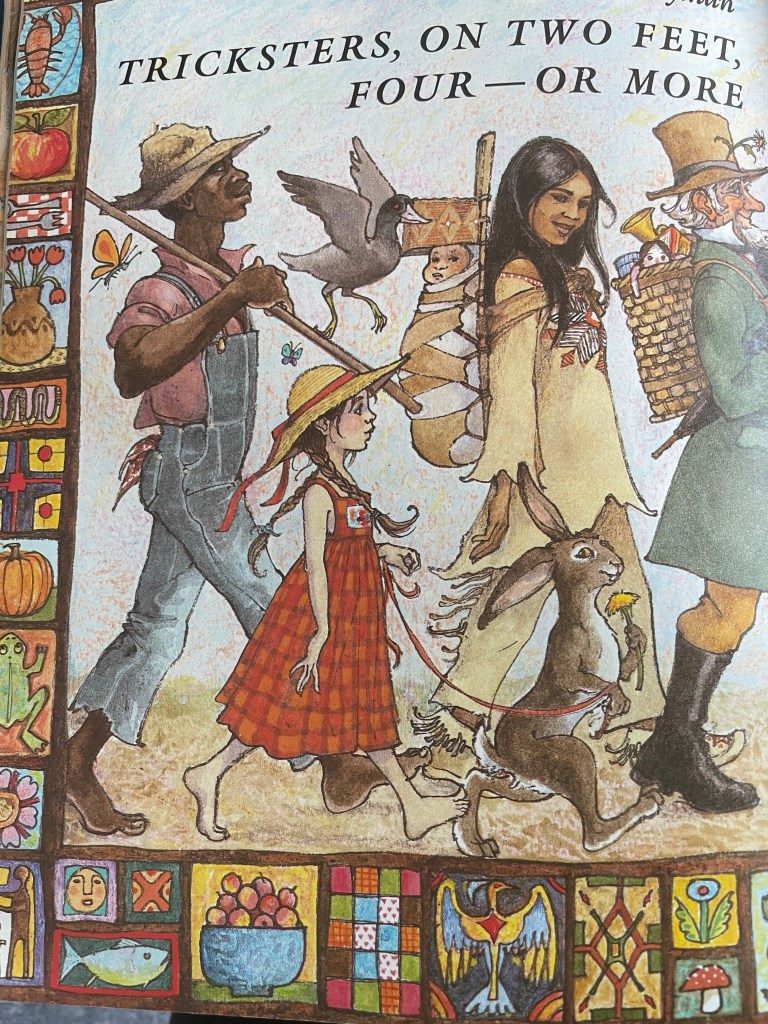
Tricksters use their wits instead of their fists to outsmart more powerful opponents. Stories about these wily characters are told all over the nation.

The cropper who drove a hard bargain keeps his hoe at the ready, and his head up.  A woman of the Mohican carries the god Wasis on her back while keeping an eye on that scamp Brer Rabbit. He gives the reader the side-eye as he leads (or is led by) Mr Man’s little girl – and is that Uncle Sam hefting a pedlar’s pack? The mud hen who defeated Iktome flies in to join the parade, continued across a double spread in a wonderful invitation to the stories beyond.

Who would give a 398 page book as a baby gift? Only someone who truly understood the importance of starting booksharing as beauty appreciation. It’s impossible to write about all of the artists represented so I’ll do as the format dictates, and as my children showed me: page through and pick the one I love best (today).

Trina Schart Hyman used firm pencil outlines for these fresh interesting characters which she then filled with watercolour wash. The superb shading suggests the dust of the open road, and the figures are all gesture and action – who doesn’t want to follow them wherever they’re going? TSH as a designer knew how to pack a page with visual interest for a child to pore over. This chapter is enlivened by superb page decorations that blend the features of adobe and cabin walls, merchant signage and mythological symbols into a gorgeous quilt patch border. I first met her work at St Kilda Library, where we subscribed to Cricket magazine – hard to say if I was first exposed to TSH’s work there, or in her many many illustrated books across genres. I do know that seeing any of her work today lifts the heart in the way it first did in 1977. 

Jackie is an intuitive children’s librarian, former columnist for School Library Journal, coordinator of a fun-filled Picture Book Group … and splendid book chooser.  We went together to the New York Public Library to hear Dorothy Butler speak in 1989 – with the size of the Fairfax County Library system and staff, we didn’t have the chance before that to get to know each other. Those couple of days were all it took for a lifetime of friendship since.

From 1993, she and her husband Alan began visiting Australia annually, so that he could teach in Canberra, and they somehow managed flying visits to Melbourne, and later Perth, as part of those trips.

The gifts – not just books – that they gave my family during that time will never be forgotten. (It was Alan who first called my son Big Bob.)

Jackie took this picture of me with Big Bob in 1993 outside her favourite Melbourne bookstore, the legendary Little Bookroom which I’ve written about elsewhere on this blog.

This book gave me a dazzling gallery of twentieth century picture book illustrators, a valuable touchstone for me once I was a fulltime parent and no longer saw new books daily.

Ms May recently paged through it with me, showing me which stories and pictures she loved, which she passed over with indifference, and the aspects of her favourite pages. The beauty of a large collection like this one can’t be underestimated.  Thank you, dear Jackie and Alan.

The roll call of featured artists includes Marcia Brown – she was 75 at the time. Here’s good old Sal, as painted by her.

The Rainbow Fish 1992

The little blue fish whizzed through the ocean with his scale flashing, so it didn’t take long before the Rainbow Fish was surrounded by the other fish. Everyone wanted a glittering scale.

The Rainbow Fish shared his scales left and right. And the more delighted he became. When the water around him filled with glittering scales, he at last felt at home among the other fish.

Delicate watercolour hues are the background for this undersea fantasy scene. Bubbles signify the dialogue between the fish. Besides his rainbow scales – foil stamped – the main character is distinguished for the reader by his yellow lips.  Rainbow Fish’s most expressive feature is its mouth, which in this picture is beginning to twitch into a smile, with the prospect of being accepted by the school around him. The clam and scallop are saying nothing.

I’ve included this book even though I have never read it aloud to any child nor ever will. Part of my rationale for this blog was to include books that were important and of their time. As I’ve previously posted about technological changes to book design and production, the printing effects in this one qualify it for inclusion here. Like most publishing for children, it doesn’t need my approbation – according to the blurb on a 2022 edition, 30 million copies have been sold worldwide.

This year, I was married and living on twenty acres. Making my own bread and soap (not in the same pot); spinning yarn and shovelling manure for the vegetables I cooked and froze … and preparing for the arrival of a new reader in the family. Big Bob was on his way, and assuming a reading posture already.

I was not buying books, certain that the ones I had accumulated would be sufficient. So I missed this debut, and it wouldn’t come into my orbit until early educators introduced my children to it. Fortunately by then, they had lived with and loved Leo Lionni’s Swimmy which inoculated them against what Marcia Brown described as:

the saccharinity of greeting cards books that possibly filled some emotional need and were very successful commercially but which did not even attempt to give a child an honest picture of himself or life around him.

Or, as Miss May observed when she was in first grade, Fish can’t live without scales!

I could be a lot ruder about the Rainbow Fish but others have done it for me. LeVar Burton’s take is the best, thanks to bookshelves of doom for relating it.

More about Marcia Brown next time.

My Old Teddy 1991

Then poor old Teddy’s head came off.

Teddy has to rest.

The wear and tear on a beloved toy is seldom as graphically depicted as in this book by Dom Mansell. The narrator cheerfully involves Teddy in her daily adventures, leading to the loss of leg, arm and ear in successive pages.

The exuberant disorder of the child-centric house is drawn to perfection by Mansell. Mum’s skirt and beads are the perfect signifiers of her skill as a toy surgeon, if the thread and giant needle don’t say it all. Bedsides are small moments of stillness in a child’s day, and it’s here that the bad news is delivered to the story’s narrator AKA Teddy’s destructor.

Mansell’s line and scene-setting is perfect for this domestic drama to play out. The Teddy Doctor stays true to her own style, and all of the details of homely disorder that comes with loving care are drawn from the child narrator’s point of view.

During this first part of my life in children’s books, I met many families among library customers, colleagues and former school friends. I was invited into their homes and the warmest welcomes came from those which most closely resembled interiors by Mansell and Sarah Garland.

I knew all about the importance of introducing books before 3, but when I saw home bookshelves overflowing with books any old how – spines distressed or completely missing, titles crammed in upside down – I was shocked. While I was doing this horrified browsing, I would be handed a favourite title by jammy hands and asked to turn its scruffy pages for an eager listener. Any public librarian knows the hard use that picturebooks get, but when I thought of my own treasured collection, I silently made the kind of resolution every prospective parent does (so that the book gods may laugh.)

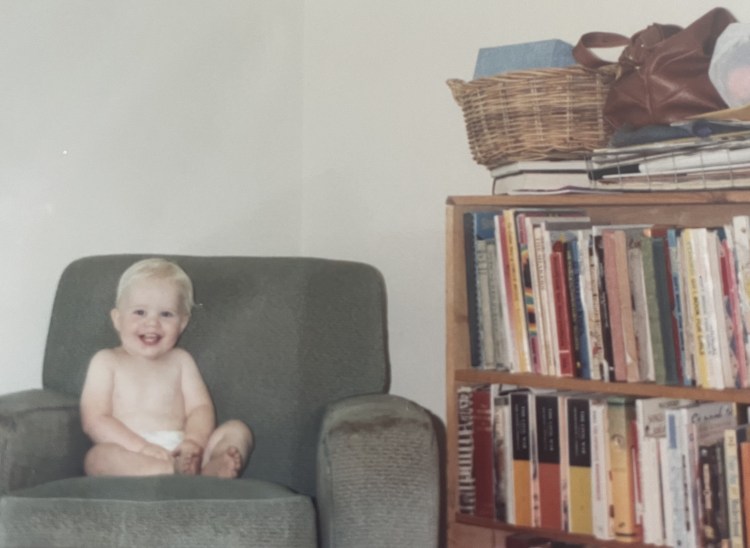
Fast forward five years: Here’s two-year-old Ms May roadtesting her new big girl bed quilt. When I took this picture, I imagined that she was rehearsing the bedtime reading of her favourite new book from the library. Those little fingers spread over My Old Teddy so protectively!

The next morning, her cot was littered with torn fragments of pages which I scooped into the cover and crawled back to Mandurah Library, Beezus-like, all apologies. After I paid for it, that entitled us to keep it. I stuck it back together with no regard for proper conservation methods but it was a long time before I felt like reading it aloud to her again.

The replacement of Ted with a newer model doesn’t diminish the affection he enjoys, and the sticky-taped book survives in Ms May’s bookcase.

To quote my favourite YouTuber Pete Beard, it’s a shame Mansell’s not better known. The only other book solely created by him that I was able to find is If Dinosaurs Came to Town, published in the same year. The Teddy Doctor is pictured escaping the Tylosaur, and Teddy’s in a heap of rubbish but still waving.

The Chocolate Wedding 1990

Lulu is to be a bridesmaid at her aunt’s wedding – her dress has ‘two hundred petticoats’, she has boasted to her school friends. In the confusion of preparations for a home reception she and little brother Willy are banished to the front room where she unfortunately eats many of the Easter treats she has brought with her.

This page is part of the four page fever dream that her chocolate binge inspires in Lulu, sleeping on the sofa in the dark. The chocolate sea literally swamps the children as they float and then surf on a biscuit; the family are waiting for them on the golden sand as the reality of Lulu’s night nausea causes the dream to fade like foam on that shore. As well as providing the setup for Lulu being left alone the following day for further adventures, Simmonds is showing the reader what elements of illustration and text to pay attention to, and how, for the rest of the story.

I heard and absorbed from other children’s librarians, early on in my career, that “comics” were either despised or dismissed as suitable only for ‘reluctant readers’. The exceptions were Asterix and Tintin, on the shelf of my school library and each subsequent one I worked in : Raymond Briggs’ Father Christmas was embraced when it won the Kate Greenaway award, and the Ahlbergs’ early works like The Old Joke Book and The Brick Street Boys were acceptable.

This was a source of secret shame to me because, like Simmonds herself, I grew up reading comic strips wherever I found them, even if only half understood. (It had to be explained to me what a chimney sweep was.)

. My dad’s bookcase included Jules Feiffer’s Sick Sick Sick and a book of motoring cartoons by Brockbank called Round the Bend. I knew they weren’t the same content as printed in my English weekly, Princess Tina, but devoured them anyway.

Simmonds describes her own childhood comic reading in Paul Gravett’s biography : ‘I liked how you can voyage around the page.’

I’m utterly convinced that reading this variety of graphic styles taught me to examine every part of a picture, using the accompanying text as a guide – when it seemed to directly contradict the image, that was an invitation to look, and look again. A wonderful contemporary artist called Aśka says this better than I ever could : check out her website.

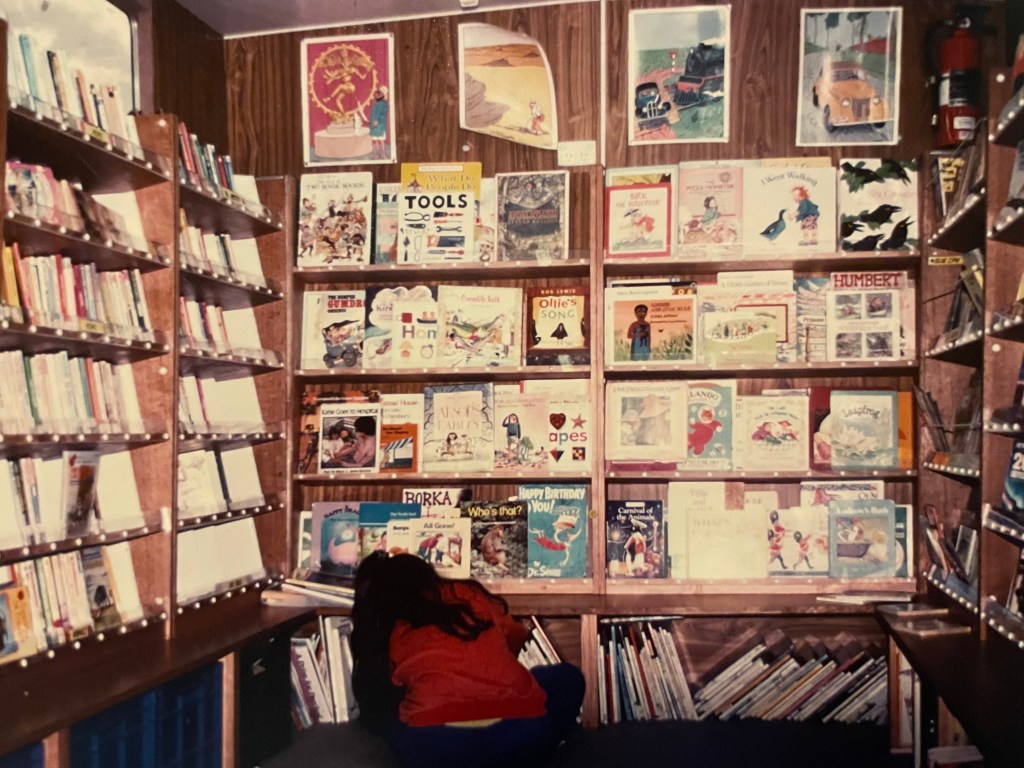
It was during this coming decade that graphic novels for adults and children would gain in status, and shelf space within libraries. I’d left the Titanic behind in Ballarat and moved to Moonee Valley Regional Libraries, and back to the big smoke of Melbourne. A combination of city and country services delivered in various ways. Here’s a picture I took (with her permission) of a young reader on board the Broady bookmobile, with that scamp Tintin as wall art.

In the future, The Chocolate Wedding became a favourite of Ms May, and Big Bob wouldn’t have hesitated to eat the bride.

We’re Going on a Bear Hunt 1989


Uh-uh! Grass!

Long wavy grass.

We can’t go over it.

We can’t go under it.

Oh no!

We’ve got to go through it!

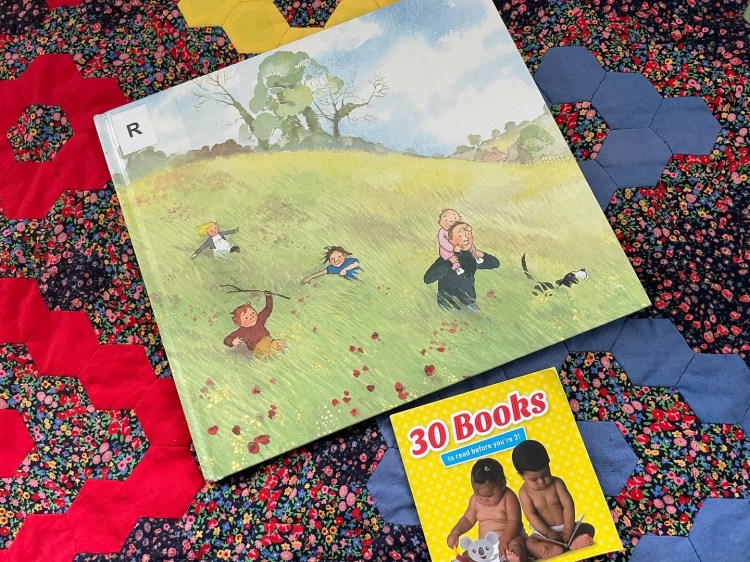
Helen Oxenbury’s family doesn’t falter as they go through all of the obstacle on their bear hunt. Father carries, cajoles, shelters and protects each child individually as needed. The baby, as we might expect from this artist, is no burden but an active player – cared for at key moments by each family member in turn. The small reader is rollicked along by Rosen’s text, as fast or as slow as their reading adult likes. (Here’s his own reading.)  The wordless end to the story is perfect: the poor bear shambles back along a Norfolk beach, waiting for the next time a careless bunch of humans accidentally routs him out. Fortunately for them, bedcovers are the best defence against tooth and claw.

Before leaving Australia in autumn 1988, I applied for a small Library Association of Australia travel grant to enable me to observe innovative programs for children under 5 and their parents. Fairfax County hosted many storytimes and toddler times, and I was inspired by observing the varied presentation styles of my colleagues.

The travel grant gave me the funds to spend time in Baltimore and surrounds. Carol Roberts, librarian-storyteller extraordinaire, took me with her as she visited children being cared for by family day caregivers in homes.  That was a day that demonstrated the value of relationship building and story sharing that I have never forgotten, and the friendship forged still warms me. I also visited Enoch Pratt Free Library and briefly envied its wood panelled children’s room and inbuilt fish pond with a fountain; before I saw that they used a classification system completely unlike Dewey’s. I would have been lost, so thank goodness Donna had gone to Fairfax County. Their stacks were identical to the ones in Ghostbusters.  There was enough money left for a return train trip to New York to see the inspirational work of Hannah Nuba Scheffler at the Hudson Park Library.  It was the home of the Early Childhood Resource and Information Center and the prototype for practices and programs that are well established three decades later. I thought of Hannah and her team when I toured City of Melbourne’s recently opened narrm ngarrgu.

Central to all of this programming was the selection and sharing of terrific picturebooks for toddlers and preschoolers and I still clung tightly to Dorothy Butler’s Babies Need Books as my guide. At the very end of my exchange year, in the spring of 1989, New York Public Library hosted a one day seminar on the importance of the early years, with DB herself as a keynote speaker. I couldn’t miss it. Another FCPL children’s librarian, Jackie Gropman, was also going. She suggested we meet for dinner beforehand, and we haven’t stopped talking children’s books since. In a letter to my mum, I said “It was wonderful and a fitting end to my year here, being a gathering of people who think the same way I do.”

 Other bear books have captured my heart – Michael Hague’s wistful slumping ted was licensed as a poster by FCPL this same year – but Oxenbury’s is one of the best. Versions of the book since then are indicative of the ways in which story sharing in public library spaces have evolved : it’s now both a board book and a Big Book.

Back in Ballarat, I began to hunt for pastures new myself – swishy swashy, swishy swashy, swishy swashy.

Shy Charles 1988

“He saved my life,” moaned Mrs Block.

“He’s a prince, a gem, a hero!”

And everyone shouted, “Thank you, Charles!”

But Charles said …

Zero.

Rosemary Wells makes the eyes say it all in this illustration of the moment that adulation floods over Charles. Amid the chaos of first responders attending to babysitter Mrs Block, the fire chief in his Keystone cops frock is lifting his paw for a high five which Charles has no intention of returning.

Charles’s parents, dressed to the nines for their interrupted date night, clasp each other in the desperate shared pleasure of seeing their child praised by others. Charles gazes at them with fond resignation, knowing that he will survive their false expectations of what normal is. Turning the page, he reverts to being himself. 

Wells, like her contemporary Sandra Boynton, is all about human dynamics in fuzzy form. I knew one, and would meet the other’s work, in this year.

The exchange proceeded apace. All my exasperated boss said was, Can’t you just stay put? when he had to state in writing that Ballarat City Council would cover my worker’s compensation for the year.

Donna Matthews had changed jobs, and was now at Fairfax County Public Library :  I was to be the Regional Children’s Librarian at Reston, Virginia, from the end of April.  I wasn’t eligible for a Green Card but was able to wrangle a twelve-month visa, with the helpful advice of someone else who had done an academic exchange.

Our combined recklessness led to an experiment that enriched both of our lives. Donna, who was nearing the end of her career, loved the ‘small town’ experience and travelled to every Australian state during her year. Many Aussies mourned her when she passed away a few years ago.

Here I am, recently arrived and still with no clue – but have adopted the loafer with alacrity. This poor child looks less than thrilled to meet me.

The scale of the library was way beyond my experience. Fairfax CPL had at least 700 employees, and Reston as a regional library employed at least ten librarians. I had three part-time children’s specialists supporting me in delivering programs which had been planned months in advance by a committee of the seven Regional Children’s Librarians. Summer Reading had Garfield as its mascot, professionally designed and printed materials as collateral, and huge numbers of children signing up.

Fortunately for me, Amy was another RCL who lived in Reston so she could give me a ride to and from the meetings all over the County. Her book knowledge, good humour and friendship were a vital anchor in this time, and remain so to this day. The clipping above was saved by her.

I’m not a children’s librarian who dresses up, but for this wonderful woman, I did. She even supplied Red Riding Hood’s cloak.

More about this fabulous year next time.

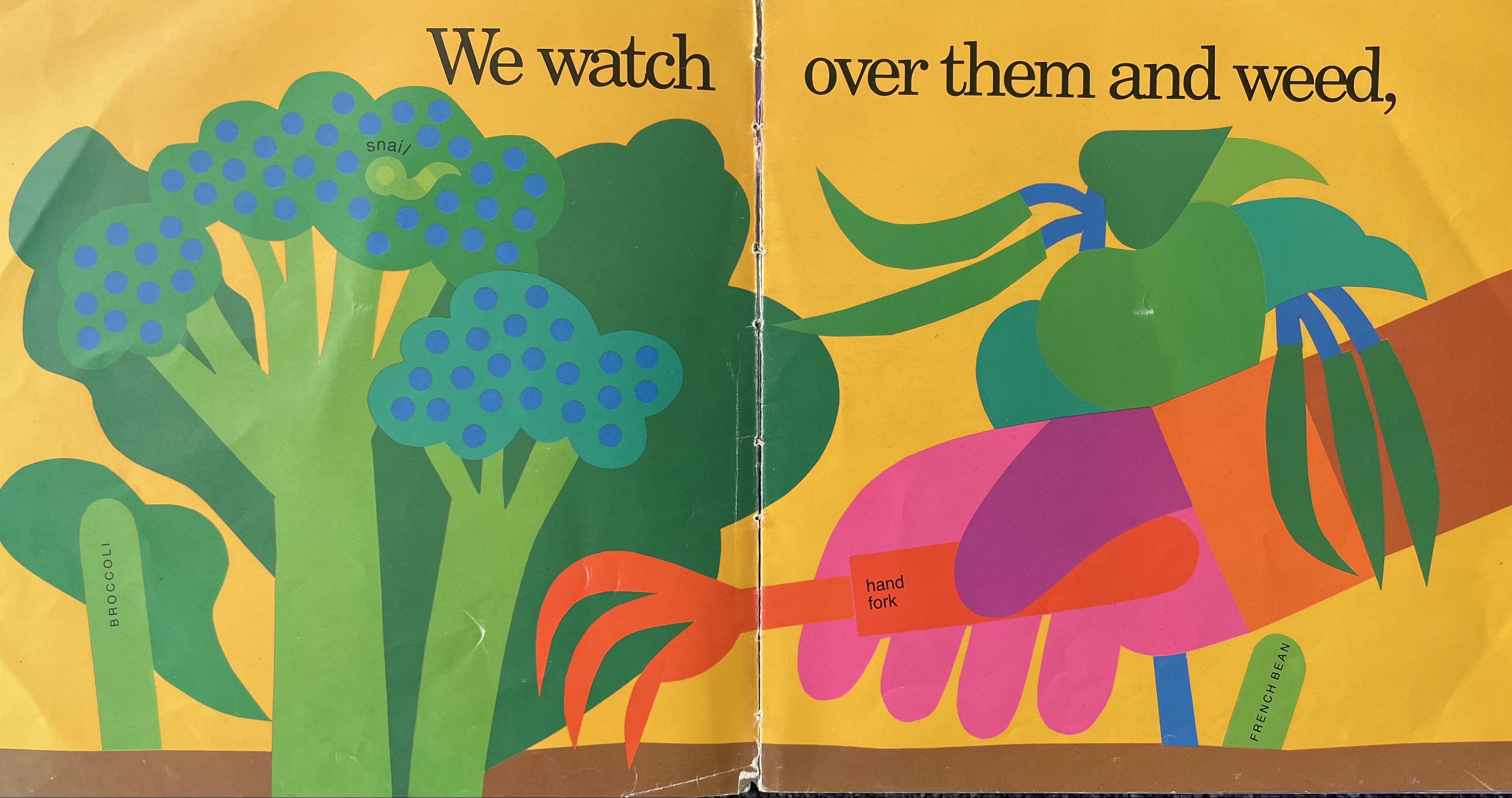
Growing Vegetable Soup 1987

We’re ready to work, and our tools are ready, too.

We are planting the seeds, and all the seedlings, and watering them, and waiting for warm sun to make them grow, and grow, and grow into plants.

Lois Ehlert’s childhood was spent playing with offcuts from her father’s workshop and her mother’s home sewing, and her artistic practice evolved from this – this book, her first, was published when she was 53. The plants are observed at ground level, their shoots and tendrils curling from under the artist’s scissors. The young reader can imagine herself crouched in the rows between plantings, watching them grow before her eyes, with the minimal labelling supplementing the text.

Big Bob and Ms May loved this book, and this is the family copy, battered from many readings in the 1990s. We all became up-close-and-personal with zucchini during this time.

I had moved to Ballarat partly because my parents had bought 20 acres half an hour from there. My sisters were independent and had left home, and that left Mum and Dad to pursue their dream of building their own home from scratch. Mum built rock walls from the volcanic stones on the property, a long and loving labour to shelter her extensive garden.  After a lifetime of working in textiles, she began to make her own cloth by handweaving. Dad was a metal worker who could turn his hand to making sheds, gates and the most indestructible compost bin ever. I am a natural brown thumb. Whenever I gave a talk to a parents group, they would present me with a house plant which I’d save from certain death by immediately passing it on to Mum.

I was attracted to the idea of working in an American library. Having spent the previous decade reading everything that ALA produced, I felt it would be a good next step for me. The ideals of programming for families with babies and toddlers, sparked by Dorothy Butler’s Babies Need Books, were espoused in those journals and I was excited to see them in action for myself. I’d travelled to New England and Manhattan on two holidays, and ‘knew’ I’d feel right at home on the east coast. 

I’d read in a journal that the library school at the University of Aberystwyth in Wales compiled a list of people worldwide who wanted to exchange jobs. Today, this would be three clicks:  finding their website, locating and scanning the list, then directly emailing the person. (I’ve just checked Facebook to see if there’s a Page for prospective exchange partners, and there isn’t one I can find.) 

Not so in 1987. I hand-wrote UA a letter and put a stamp on it, shoving it hopefully into a slot marked Overseas Mail at Ballarat Post Office. After a fortnight, I received a stapled photocopied list, arranged alphabetically by country. Just the one line for each person’s dream: their name, library, and the country of exchange they wanted.

I found Donna Matthews on that list. She wanted a 12 month exchange in either Australia or New Zealand, and she worked at a library I’d actually heard of – the Enoch Pratt Free Library in Baltimore. Another couple of months went by as we got to know each other by letter, made a basic agreement to do it… and only then, asked / told our respective bosses.

In Elhert’s words, At last it’s time to eat it all up.

The Jolly Postman, or, Other People’s Letters 1986

Soon the Jolly Postman

We hear tell,

Stopped at a door with a giant bell

and a giant

Bottle of milk as well

With a postcard for … guess who?

Janet Ahlberg’s lines flesh out the verse with economy of line but plenty of gesture. Mr V. Bigg is stuck at home, wearing his tweedy vest, not pleased to be hearing from an old adversary. A gigantic grandad is squinting at the absurd holiday snaps on the card with only his earring hinting at his colourful past. Baby is doing what babies do – reaching for a block, or a chip-off-the-old and about to bite the postman in half? And yet he has a sippy cup and half-eaten biscuit that any young reader can relate to.

Allan Ahlberg’s lyricism with simple verse made them the perfect picture book creators of this era. The rhythm of the book takes the successful formula of Peepo! (1981) and builds on it. The cast of Each Peach Pear Plum (1978) are reprised on the cover. The alliteration of the last two lines on this page are an example of his playfulness with words. Much has been written, and by better writers than me, about Janet Ahlberg’s genius: Allan’s touching Janet’s Last Book (1997) tells the story of their twenty year partnership.

I’ve always been envious of the English post – a pile of letters by your breakfast plate, to be savoured with toast and tea, having been courteously delivered through your front door.  An anonymous bike rider shoving letters into a cold little box at the suburban front gate by mid-afternoon if I was lucky was yet another example of the difference between fiction and real life.

Letter writing, and receiving replies from loved ones, has kept me holding onto the idea of myself through many external changes to my world.  We came to Australia from New Zealand when I was 9, and by 1986, I had moved seven or eight times. One of my favourite correspondents was my Aunty May who kept me informed of cousins and their adventures in a landscape I barely remembered.  She took a great interest in my career as she had trained as a Froebel educator, and generously shared her expertise and book ideas gleaned from her work as a teacher of young adults with disabilities.  It was a great day to open my rented post box and see an airmail envelope from her.

Invited onto a very active Children’s Services working group, I learned a lot about families in Ballarat district through contact with playgroups, maternal and child health, as well as the toy library. As a city of 80,000 people, Ballarat boasted its own television station: BTV6. Their local programming included a morning talk show, and a Saturday morning full of children’s cartoons, and I was asked to appear as a guest on both during school holidays and Children’s Book Week.

I wasn’t quite the sensation I claimed in my last blog post – I learned the hard way that their budget did not extend to makeup artists on the weekends. Nevertheless, I was very touched to receive a handwritten letter later that year from a woman on a remote Western Victorian property, saying she had ordered a book I recommended, and always found what I had to say so interesting.

A blog doesn’t have the impact of a barber-striped envelope with the postmark EAST OF SUN WEST OF MOON that the postman brings to the Giant’s door.  But I have needed very little encouragement since this, the tenth year of 40,  to broadcast. 

The Year without A Book 1985

I thought I’d made a big mistake.

Leaving a library with only one branch in a single local government would widen my horizons, I thought. So, at the beginning of this year, I applied to be the Children’s Librarian at the Central Highlands Regional Library Service. Based in Ballarat, the library service was made up of 22 branches and two bookmobiles, funded by 14 separate local governments.

It was my first experience of the logistics involved in keeping a network of large and small libraries supplied with fresh bookstock. I was in awe of the regional library staff who continually packed and unpacked boxes for all the families across the region, some of whom were borrowing from a cupboard in a shire office or a shelf in someone’s homestead. My head whirled with trying to calculate whether the budget contributed by the Shire of Lake Bolac was enough for them to have copies of all the shortlisted picture books for that year. And did I mention that there was a City of Ballaarat, and a Shire of Ballarat, and a Shire of Ararat and City of Ararat, as separate funders among the fourteen LGAs.

It was also the first library I worked with a completely manual circulation system, and a card catalogue to guide customers. Cratchit-like, I perched on a stool each morning behind the old-fashioned pine library desk, counting cards from the loans of the day before, and then entering the statistics in a large red ledger. I had learned the theory of the Browne system in library school, and experiencing it now was like having my smartphone (not yet invented) taken away and replaced by two tin cans and a piece of string.

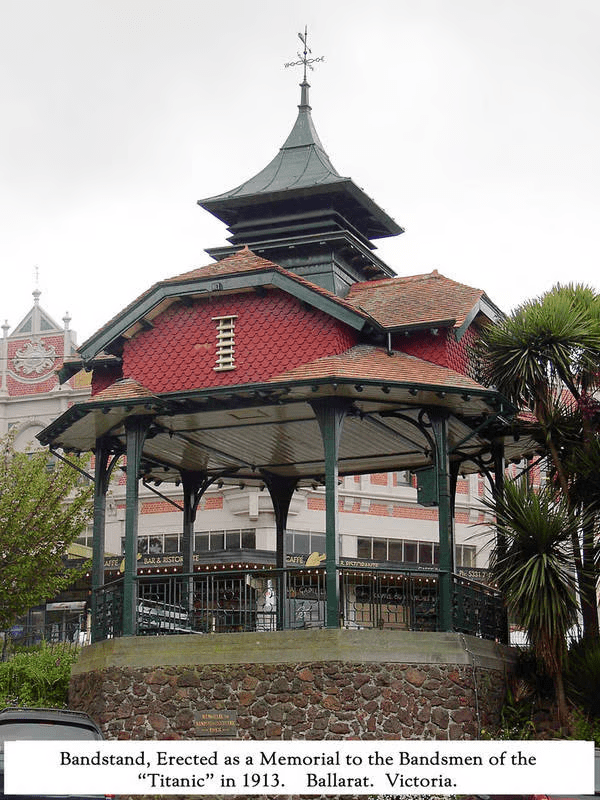
I was lonely, cold most of the time and beset by chilblains, due to my office being in a turret far away from the nearest sputtering gas heater. However I found that I could do the job easily, once my assistant did the working out of the percentages of the book vote; I fitted into the workflow and began getting to know customers and stock. And my view out of the turret window, just visible in the photo above, was of the fabulous Titanic memorial bandstand .

My excellent predecessor Liz had been, like me, inspired by Dorothy Butler and had started monthly Preschool Storytimes, and in preparing for them, I read the many picture books published before 1977 filling the wooden shelves. The daily newspaper was always up for a story, so marketing of any programming was easy. The head of the region staff turned out to be a fantastic puppeteer. Best of all, I met and talked books with the small people and their families who became familiar faces, not just cards.

When I was researching for this blog, I wondered how nothing published in this year still resonated with me. I found out that the Children’s Book Council of Australia made no award in the Picture Book category in 1985, the judges saying:

Although the picture books offered for consideration this year exceeded half the total number of  entries, it was the unanimous decision of the judges that none of these reached the required level of excellence demands of an award winner. Few of the entries approached that balance and integration complemented by a high standard of design and production which is required of the award-winning picture book… With a few exceptions, there was little variety in approach and technique, however some interesting variations in style were noted. In many of the picture books, the illustration suffered from a lack of attention to the text while others displayed an inappropriate or indeed inept handling of colour and design or a lack of technical expertise.

Ouch!

This sign perfectly encapsulates my early days in Ballarat. It’s in a suburban street of that city, 3 km from the main branch in Camp Street. Like most of the photographs for this blog, I took it in the second decade of the 21st century. I have no idea whether the bookmobile stops there anymore and how could I? It will always be the other alternate Monday.

!986 would be a lot better, book-wise – I bought fur-lined boots to cut down on the chilblains and became a TV sensation.

The Little Mouse, the Ripe Red Strawberry and the Big Hungry Bear 1984

BOOM! BOOM! BOOM! The Bear will tromp through the forest on his big, hungry feet, and SNIFF! SNIFF! SNIFF! find the strawberry …

No matter where it is hidden, or who is guarding it, or how it is disguised.

Don Woods’ soft pencil drawings take the reader right into a rodent-scale environment. The lush greens of the abundant garden are both paradise and potential danger to the quivering hero, who retreats to his safe home. An unusual narration technique has the Little Mouse addressed directly by a godlike voice which warns, then guides, and ensures that LM gets what he most wants.

In 1984, I would make notes, and set aside reviews of books I wanted, as I read the library and trade journals that St Kilda subscribed to.  Most were from the US and UK so there was a delay before local booksellers acquired them: they would bring in boxes and crates of books that would be left for a few days for me and the Assistant Children’s Librarian to look through and select to order from our budget. Other interested staff could browse, and talk about their favourites too.  Expenditure was strictly controlled and to buy from just anyone, let alone to attend a party with a purchase order in hand, was unthinkable. I didn’t even know this book existed.

I enjoyed the freedom of this choosing, and relished regular meetings with other children’s librarians. When I’d been a student and just the Assistant librarian myself,  I’d kept my mouth shut, but now I was invited up to the high table with people much more experienced and knowledgeable than me. I remember a wonderful evening where others thoroughly unpacked Raymond Briggs’ work – my ill-informed remarks and half-baked opinions were tolerated with good grace. I wish all of these superb women well, wherever they are now.

There was no local bookshop near the library but I continued to haunt The Little Bookroom in my spare time – I’ve written about the legendary Albert Ullin in a separate post on this blog. I bought this, and many other reference books for my own use, there.

Being sold through party plan must have assured its survival until a dozen years later, when my son borrowed this duo’s Twenty-Four Robbers from our local library. Having my own personal book budget, and no restrictions on parties, I soon acquired this title and The Napping House which we all loved. Share half with me is a family phrase to this day.