Featured

Don’t Let the Pigeon Drive the Bus -2003

Hi! I’m the bus driver. Listen, I’ve got to leave for a little while, so can you watch things for me until I get back? Thanks. Oh and remember:

Don’t let the pigeon drive the bus!

On a Saturday night in March of 2003, there was an unusually severe windy rainstorm in Perth. The wind drove the rain under the roof of the Nedlands Library, where it dripped through the ceiling of the children’s room. By the time the damage was discovered on Sunday afternoon, the carpet was still underwater and 80% of the books were damp to wringing wet. There was some roof leaks in the main library as well.

The library closed for a week-long clean up. After assessment from the State Library of WA – most of the stock belonged to them – the books were removed as soon as possible to prevent the danger of spread of mould. Throwing them into a trailer to be taken to the council depot reduced everyone to tears.

About 70% of a library’s stock is out on loan at any one time, so the collection was not devastated completely. We were offered additional books from State Library of WA, as well as very generous community donations from residents, the Children’s Book Council of WA and booksellers. A small children’s library space was established at the other end of the building during the refurbishment of the room which took about 9 months. Storytime was suspended for a time.

As always I turned to picture books for comfort and relief, and so this was Mo Willems’ moment.

Willems read comics growing up, he tells young fans. He learned from them how to action-pack a square, using a character made of a few lines.

Many writers of picture books have their protagonist address the reader directly but Willems’s pigeon is in a class of its own. Enlisted by the bus driver with the request that is the title, readers are fascinated to see and hear the bird’s requests, sweet-talk, confidence, pleading and the final feathery tantrum. Willems’ design and use of speech bubbles is perfectly placed to keep the pages turning.

Two pages from a children's picture book called Don't Let the Pigeon Drive the Bus with illustrations of a pigeon by Mo Willems.
Hey, I’ve got an idea.

I’ve been reading and enjoying comic strips long before the 40 years began. My father stuck funny cartoons on the wall of the smallest room in the house. My parents never said what I could and couldn’t read so I regularly took Dad’s copy of Sick, Sick, Sick by Jules Feiffer from his bookshelf, even though I definitely did not understand most of it.

Princess was my weekly magazine and I was ‘getting’ these jokes in 1967.

Ms May had moved primary schools at the start of 2003, to be close to where I worked. Students would come to Mt Claremont Library from the school and it was probably during one of these visits with her Year 4 class she heard me read Don’t Let the Pigeon Drive the Bus! for the first time. (As this picture shows, she had moved on to chapter books as an independent reader, so we weren’t sharing many picture books together.) She remembers that she ‘had never heard a book as funny as that.’ She had not yet discovered my Princess annuals.
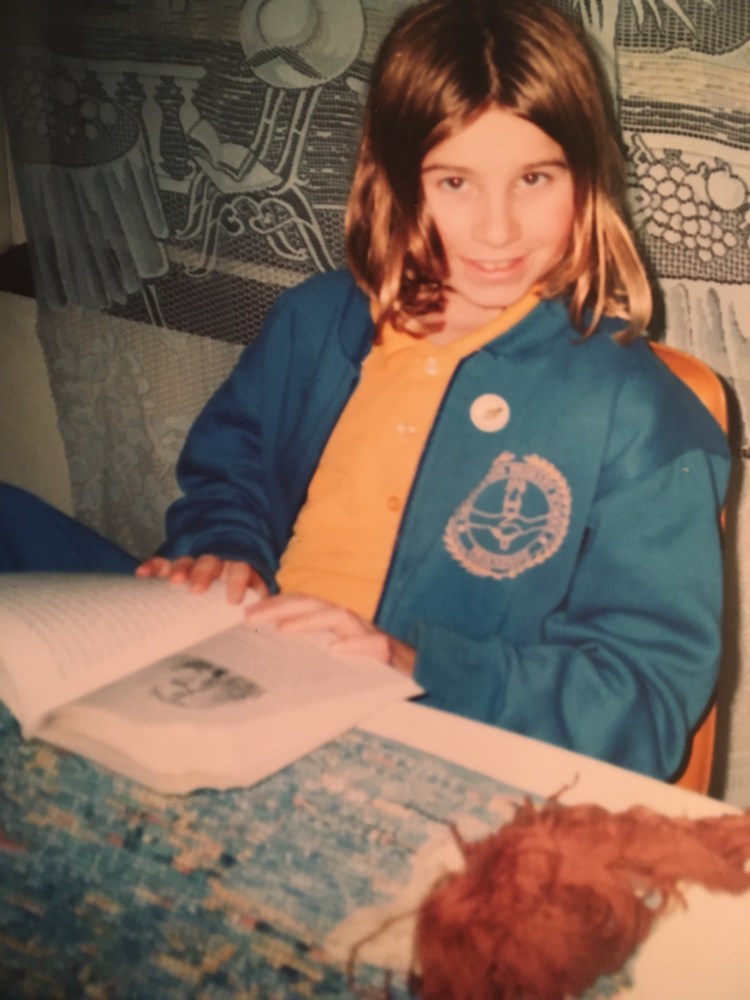
Photograph of child in school uniform reading a book on a kitchen table
Miss May wearing Gould League badge, taking a reading break from making doll’s wig.

Ms May was taught by the excellent Mrs Ryan, who signed everyone up to the Gould League. To this day, she knows a wood duck from a mountain duck – and we recently enjoyed Mo Willems’ draw-along together, so the pigeon lives on.

I must have shown too much enthusiasm for it among colleagues in later years – happy birthday to me!

A pigeon driven bus as a birthday cake with the Better Beginnings team, 2011

Where is the Green Sheep? 2004

Here is the wind sheep,

and here is the wave sheep.

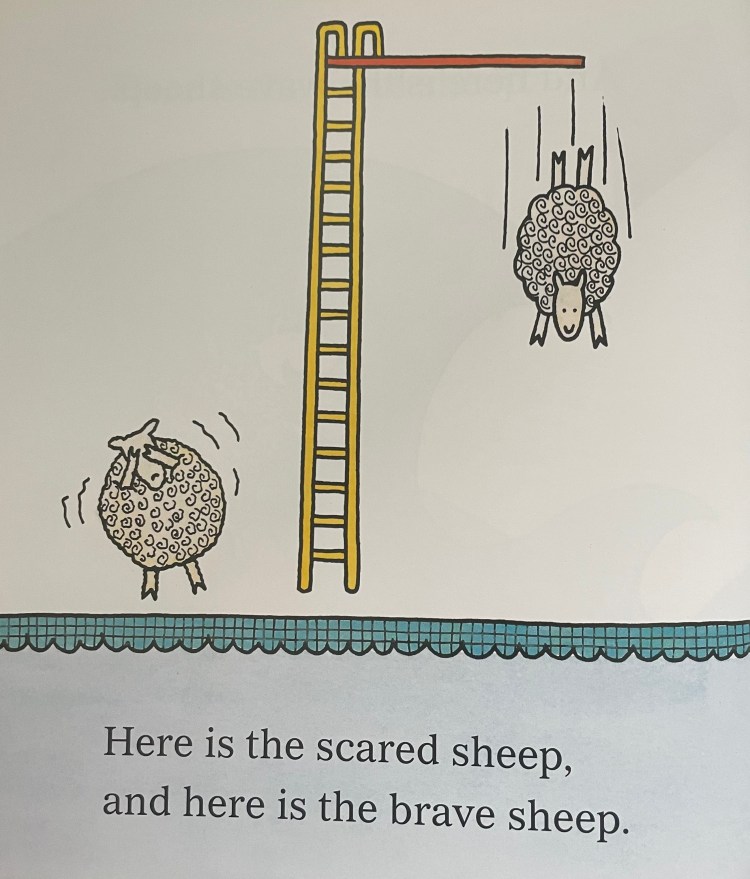
Here is the scared sheep.

And here is the brave sheep.

But where is the green sheep?

Author Mem Fox has chosen an animal whose name in the singular and plural are the same – and then has made that word the anchoring rhyme of the book, resulting in a hectic word ride that tiny readers want to go on again and again. These four lines are a delicious double-meaning action verbs and emotions. The kite is controlled by its flyer with a ball of yarn that unwinds as it soars; the improbable surfer attracts attention with an upraised hoof (not drowning?) Scared and Brave demonstrate their emotions in an environment familiar to many preschoolers… An instant hit at storytime!

Fox’s success as a world-renowned picture book writer is in no small part due to  inspired partnerships with gifted illustrators.

How would Hush’s invisibility predicament mean so much to us, without Julie Vivas’s delectable watercolours? Helen Oxenbury’s babies bring Ten Little Fingers and Ten Little Toes to wriggling life.

Judy Horacek and Fox famously played off each other’s strengths to create this book collaboratively. Horacek is a gifted artist whose one panel cartoons reward more than one look : there’s always another detail to add meaning for the reader. This was her first picture book.

To pace the story, the late gifted designer Deborah Brash chose to print the repeated question But where is the green sheep? on plain white pages. These effectively allow the reader to simultaneously catch their breath, build suspense and remind them of the core quest, before the action resumes into more multi-coloured mayhem.

The last page is almost an anticlimax : that there is a green sheep after all, and they are the least responsive character, is an open invitation taken up by readers to begin the book all over again.

Big Bob and Ms May were getting past picture books now (if there is such a thing?)

BB entered a city high school as an eleven-year-old, and that entailed enrolling MM in a primary school close to my workplace. There followed several years of driving 120km per day.  We all stared wistfully at the (chicken-driven?) train’s progress down the middle of the freeway.

Australia’s national broadcaster recently launched a poll to find the Top 100 Books of the 21st century– a mere twenty five years in ?

Where is the Green Sheep was the only picture book, in fact the only children’s book, that made the list.

Recent sightings of the Green Sheep in the wild confirm its popularity : at a school during Book Week and on the wall of the Parents Room at Geelong’s National Wool Museum.

As Stephanie Owen Reeder observes in Story Stars: favourite characters from Australian picture books, ‘Despite being a sleepyhead, the green sheep has appeared in all sorts of formats – from braille to big books, board books to buggy books, and picture puzzle blocks to a boxed set with a cuddly toy.’

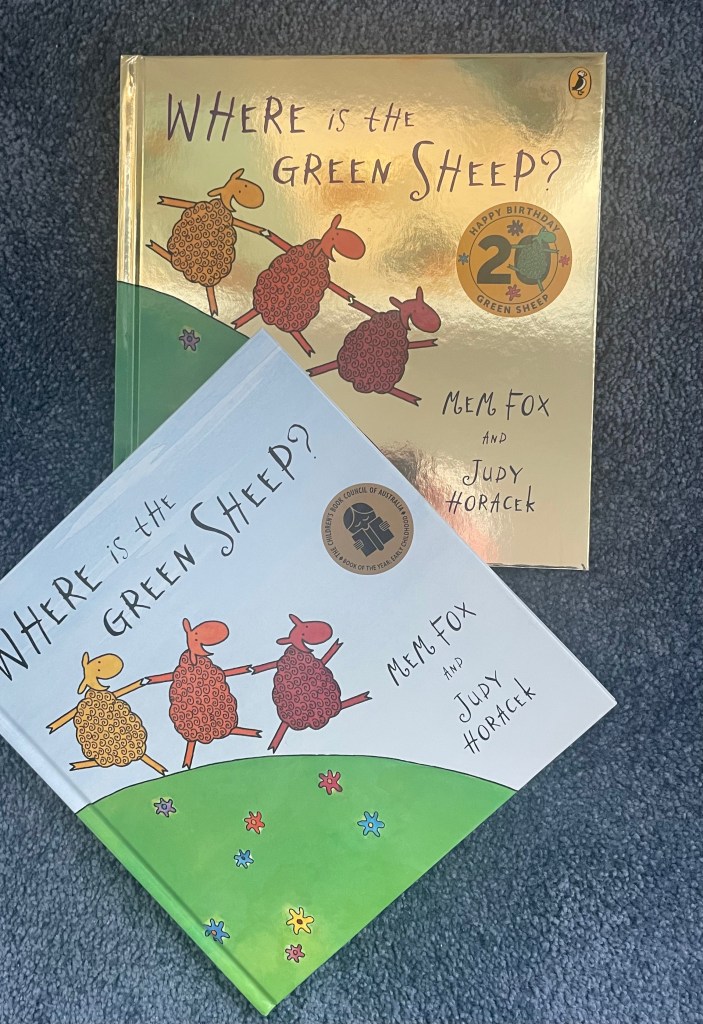
A deserved winner of the CBCA Book of the Year: Early Childhood, the book recently celebrated its 20th year of being in print with a dazzling gold cover and the issue of a commemorative coin featuring ‘the wave sheep’.

Here are two family copies. You can never have too much green sheep.

The Moon in the Man 2002

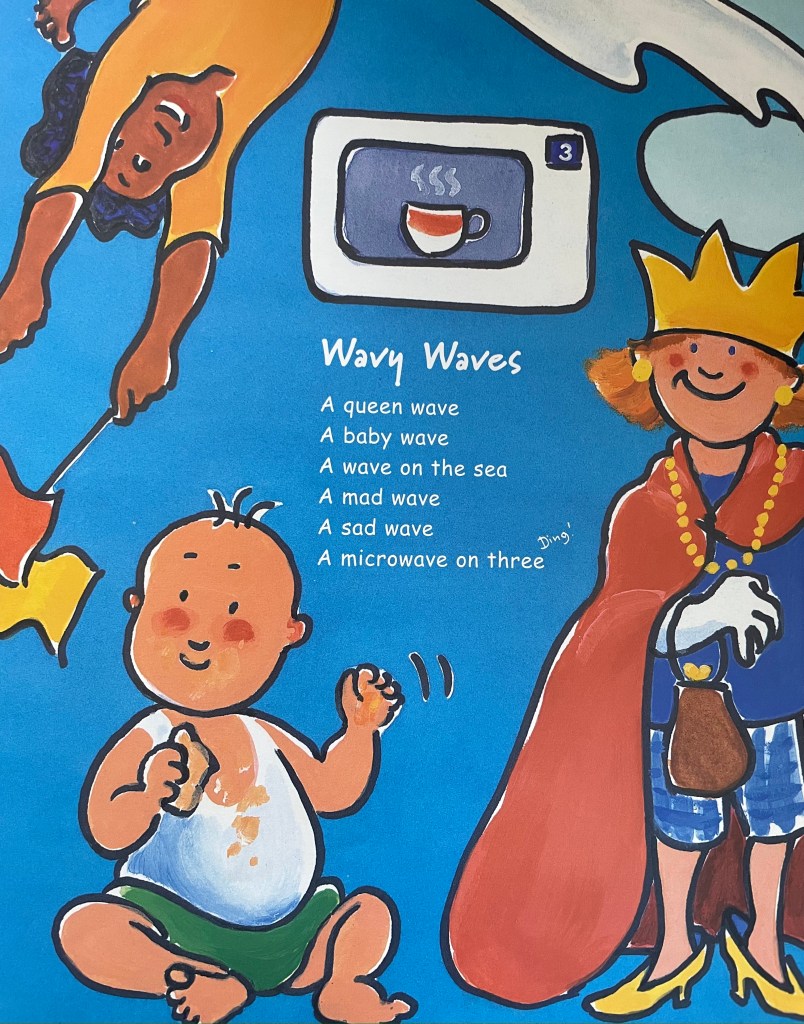
A queen wave

A baby wave

A wave on the sea

A mad wave

A sad wave

A microwave on three – ding!

The disparate elements represented in this rhyme are somehow crammed without crowding into one exuberant page – the seated baby and the dressed-up kindergartner ground readers and invite them in.

Let’s look at the child-queen in detail. She has successfully dressed herself with the accroutrements of royalty and the combination of grownup clothes with improvised train will delight the reader who loves to dress up. Elizabeth Honey’s gift is evident in capturing this active moment without a shred of sentimentality – the glove she waves with is too large which only emphasises the necessary gesture to accompany the rhyme.

The artist has used bright primaries and broad paint strokes familiar to the preschool artist – she has finished most with a thick outline in what seems (to me) a play on the pervasive black-line master of the classroom. Always in control of her marks, tiny vignettes by Honey throughout the pages give the adult guidance in sharing the actions with their young  readers.

City of Nedlands Library consisted of two branches, so in a 19 hour working week I had the opportunity to design and deliver two storytime programs as well as regular school and kindergarten class visits.  There were a few, a very few, rhymes and songs that I could share with any age group and this one remains in that number to this day.

One of the things that slightly dismayed me, after an absence from librarianship, was the reliance I still had to place on “old favourites” – the books I’d loved and shared with under-5s from the late seventies were still staples, and fresh material for this age group was hard to find. So being introduced to this book was a double win for me.

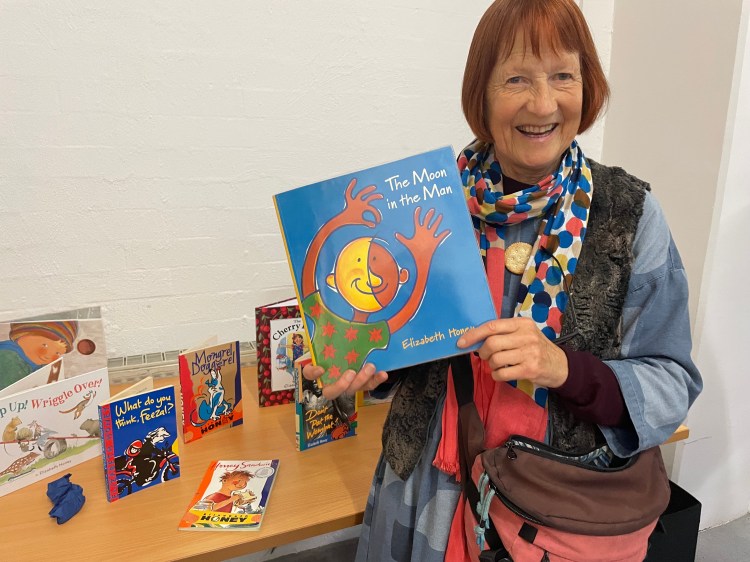
Here’s Elizabeth Honey pictured recently, supporting young authors and illustrated at their Richmond West Kids Own Publishing book launch.

My first professional conference of the second phase of my career took place in May of this year – the 2002 biennial national Children’s Book Council of Australia was held at the Hyatt Hotel in Perth. In my first fifteen years as a children’s librarian, I’d attended annual Children’s Literature weekends coordinated by the Victorian children’s and youth librarians and even braved the first Australian Library and Information Association as a speaker – also in Perth.

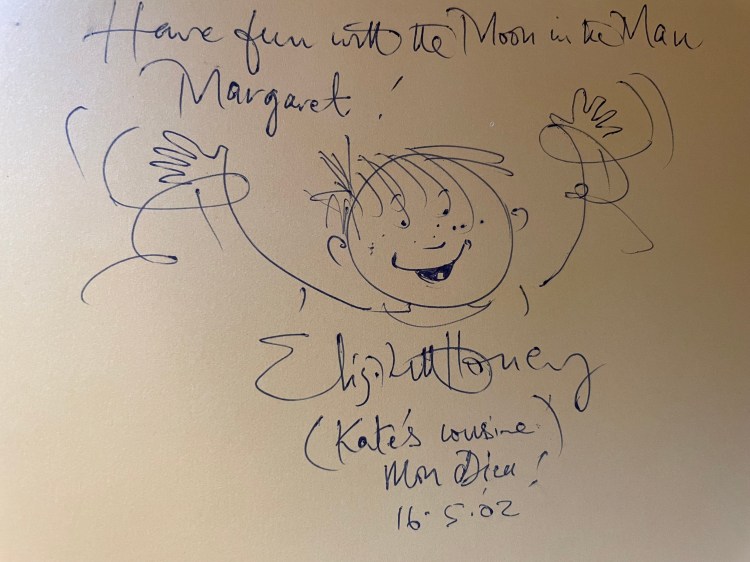
Years before, a colleague at Ballarat told me proudly that she was Elizabeth Honey’s cousin. 2002 though was my first time hearing this outstandingly talented author-illustrator speak.

We never would have got to know each other but for my dear friend Jackie who timed her annual visit to Australia to attend the conference. She rode in the bus from the airport with Elizabeth, and said, she must meet Ms May! And made it happen.

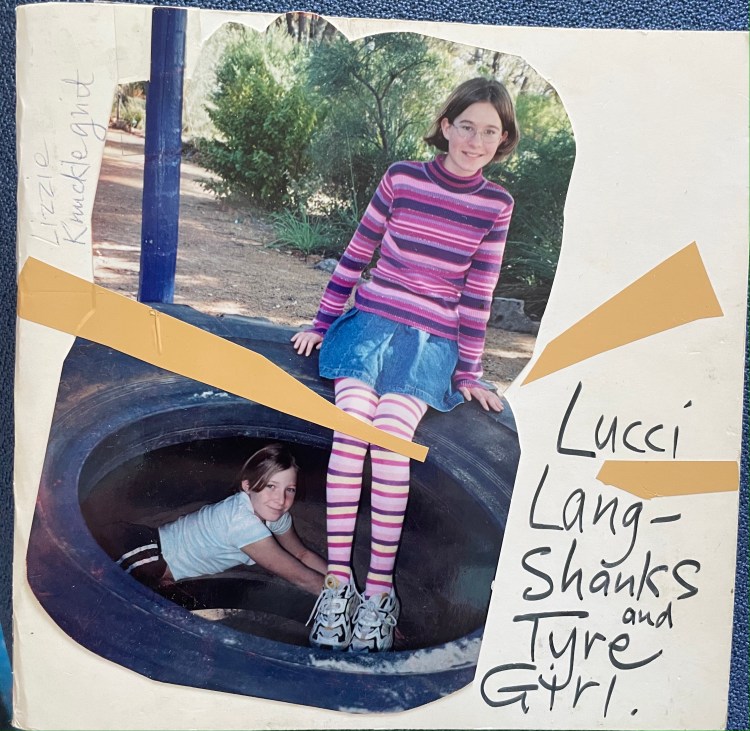
Later that year, I engaged Liz as a guest at Nedlands Library for Children’s Book Week. She stayed the weekend before with our family and cemented her friendship with MM. One memorable day we all drove up into the Hills to visit the cousins. Several weeks later, a bespoke picture book came in the post – hopefully processed by Stamping Joe.  Photos that Liz had taken that day were transformed into the adventures of Lucci Longshanks and Tyre Girl.

Liz gave me my favourite word-play on Margaret, ever: in this story I’m identified as Harigad Ma.

A resumed career; new books to play with; a reading family immortalised in print : what next ?

Letterland Book by Ms May 2001

Golden Girl from Letterland

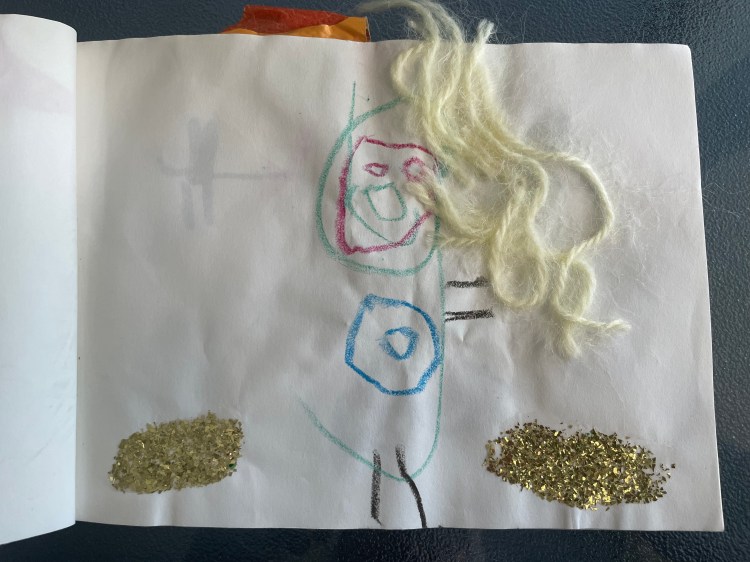
In this illustration of the Letterland character Golden Girl, Ms May has drawn a green G to be her head, before gluing long lemon-coloured yarn as hair. Are the Girl’s arms reaching to catch it or comb it? Who knows. She stands, in her hand-crayonned beauty, between two puddles of very carefully applied glitter.

This little book (14.5 x 21 cm) was made during MM’s second year of primary school and I’ve kept it ever since, long after tonnes of dreary worksheets were consigned to recycling. It looks as if it was made with a single letter to each page – possibly singly by page over a term? – and then assembled by the teacher (whose name, sadly, I can’t remember.)

A variety of artistic techniques have been used to make up the Letterland characters. As well as the ebullient use of textile pictured here, Ms May glued felt, papers, sheep’s wool, matchsticks and even fake turf onto the pages to enhance the drawn and painted characters. Munching Mike has a brass pin connecting his cardboard jaws, and Eddy Elephant a neatly concertina’d trunk. The finished book has a resulting pleasing chunkiness with characters’ ears and crowns protruding at the top like so many bookmarks.

Letterland cover

Letterland was the preferred aid to reading instruction this particular year at this particular school. I’ve stated in a previous blog, and repeat, that I was never trained in any educational pedagogy and have nothing but respect for teachers. Especially those who unlock the secrets of deciphering the little black squiggles with their small students – and encourage them to reproduce them over and over until they are fluent. I WISH I could remember her name.

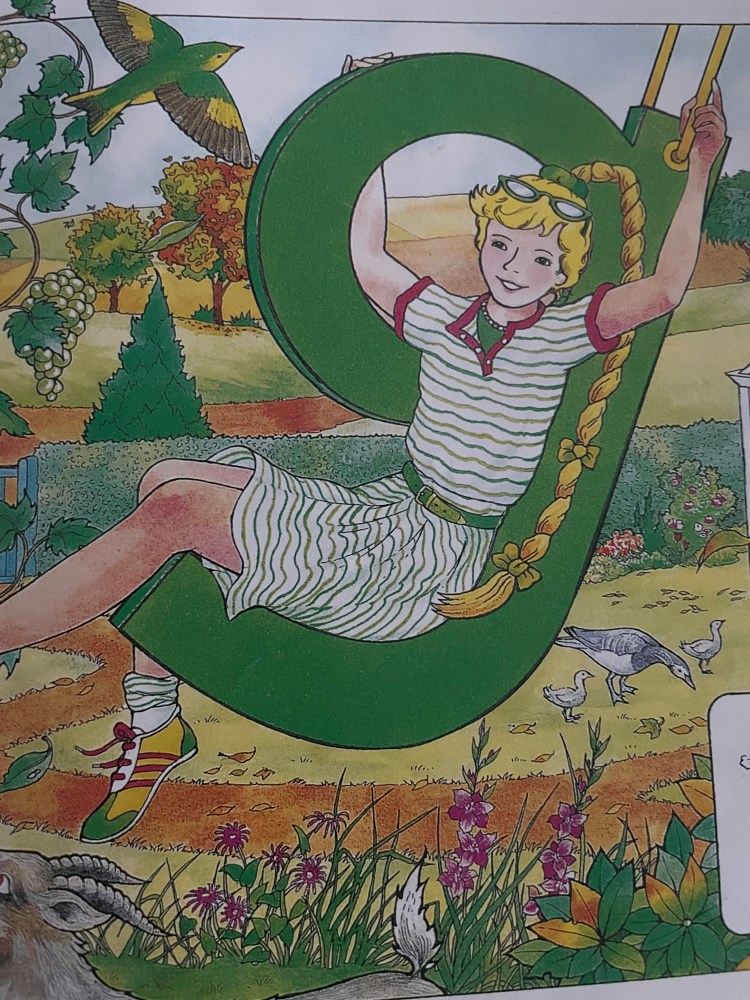
Here are Jane Launchbury‘s original illustrations for the characters so you can see the source for the pre-reading Ms May’s inspiration.

Letterland characters c2000
Golden Girl as drawn by Jane Launchbury

A mere ten years after this book was made, I would meet with Kids’ Own Publishing and my fascination with early mark-making as storytelling would lead to a new life as a publishing project manager.

In 2020, the apartment Ms May and I were sharing became a makeshift recording studio and she became Brigid in the Book Cubby. This video shows her genuine delight in reading art and words by small people creating their own books to make meaning of their experiences.

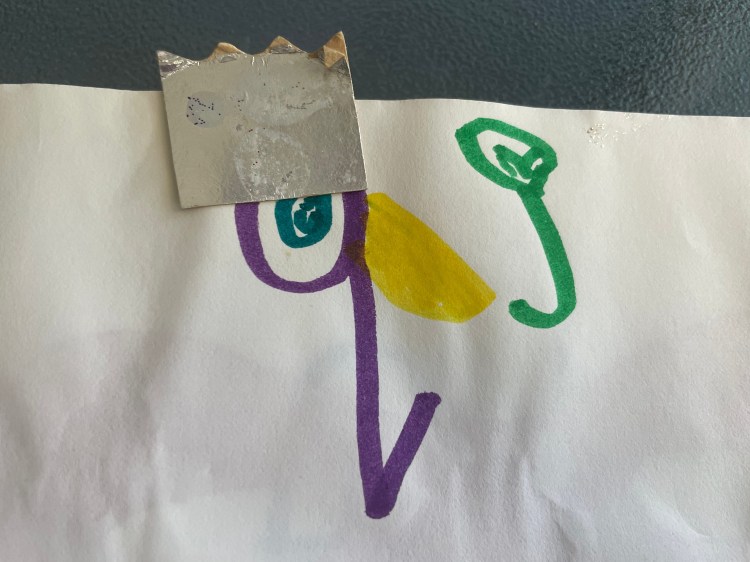
Ms May drew another girl with golden hair in another childhood notebook, also saved by me.

When she was recuperating after dental surgery a couple of years ago, I transferred her design to fabric and subjected it to my own textile interpretation.

The artist tolerated this, as she always does, with grace and kind words.

Golden Girl drawn by Ms May c2004

But I’m still keeping the Letterland Book.

Mother Goose Remembers 2000

Note: The Oxford Dictionary of Nursery Rhymes identifies this rhyme as first appearing in print about 100 years ago, but Mother Goose herself is older than that.

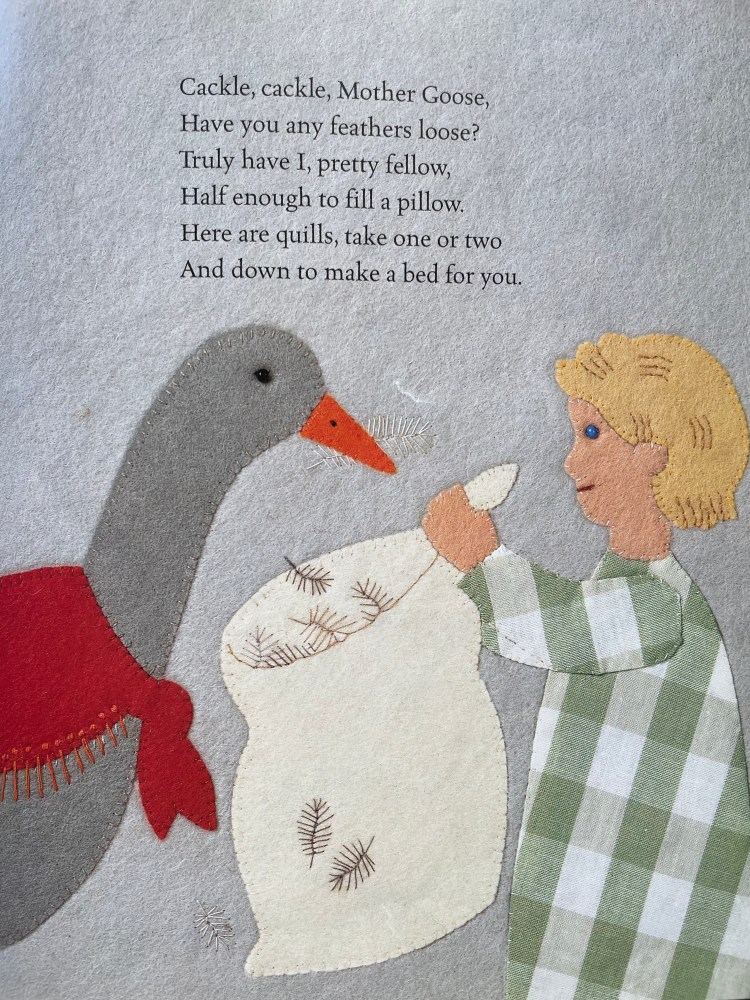
Clare Beaton‘s Mother Goose and the Pretty Fellow converse on the half-title. Mother Goose’s shawl is knotted tightly at her throat to keep it secure in flight, and has a gorgeous orange fringe. She holds a wispy airy stem-stitched feather in her beak, ready to drop it into an open pillowcase. Pretty Fellow, in his gingham nightgown (does anything say Homely Childhood more plainly?)ready for bed with his blonde head accented with comb marks made of running stitches. The figures are appliqued to the grey felt background with buttonhole stitches and oversewn.

Judicious selection of fabrics and other elements throughout the book has ensured a cohesive and pleasing collection that perfectly match the variety of rhymes. The materials used by the artist include ric rac, braid, machine-made lace, picot edging, filet crochet, bias binding and embroidered ribbon trim. These are embellished with crystalline leaves and fruit, bugle beads, and buttons, attached to the pictures by plain and fancy stitching including my favourite: couching. There’s an old-linen-cupboard authenticity to these pictures – there’s a trace of a tea spill in the tannin stained threads – that seems to match the age of the rhymes.

Fabric collage is so pleasingly tactile : Cynthia and William created a splendid Elves and the Shoemaker sometime in the 1980s that I’ve written about on my Instagram account @quiltsinkidsbooks.

In a more recent example, Kids’ Own Publishing’s artist Agum Maluach encouraged the use African fabrics with the stick figures kids made that became the book This is My Home .

The start of the new millenium brought big changes to my life. Big Bob was settled in a brand new primary school with support, and Ms May was beginning her independent reading with a wonderful teacher appropriately named Mrs Jolly.

Thanks to my own mother’s life in textiles, patchwork had been a part of my making life since late teens and was now the perfect pickup and put-down – story and song and everyday play could swirl around the table full of fabric and thread.

That was fun in itself, but it was time to go back to work. I applied for and got the job as parttime Children’s Librarian for the Nedlands Library Service. This would open the world of Western Australian libraries up to me for the next dozen years.

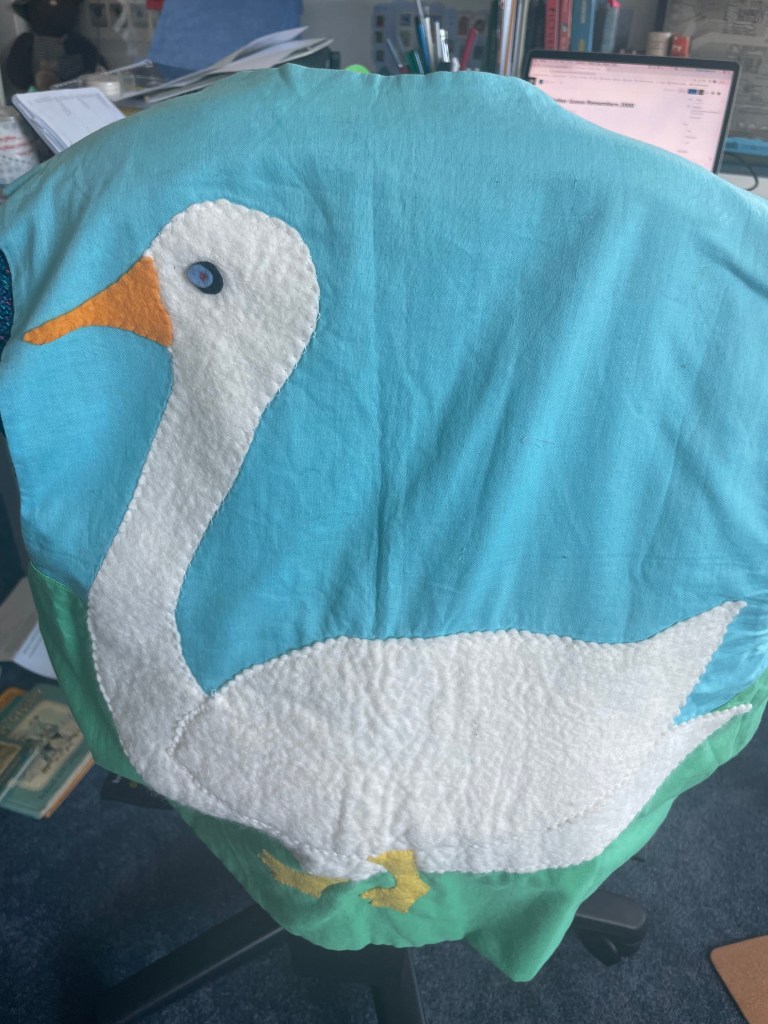
In about 1984, my textile artist Mum made me a long skirt with story characters on it to wear at Ballarat library storytimes.  She used up most of her stash of white felt on Mother Goose – the three little pigs and the Owl and the Pussycat also danced on it.

I’ve never been a librarian who dressed up: contemporary Book Weeks would be torture for me. But, as they say, you cut your coat to fit the cloth and a Mother Goose vest was repurposed from the skirt for my new library job. I could always whip it off if someone suspected me of unnecessary jollity. Nursery rhymes and songs that we had sung and chanted at home became my core offerings at story programs for the next twenty years and this book was a staple.

After years of reading review journals, in this year too I began reviewing books for both Australian Book Review and Magpies. This began the next phase of my reading life.

Who’s your favourite fabric collage artist? If you don’t have one, check out Clare’s many excellent books.

The Magpies 1999

Year in year out they worked


while the pines grew overhead


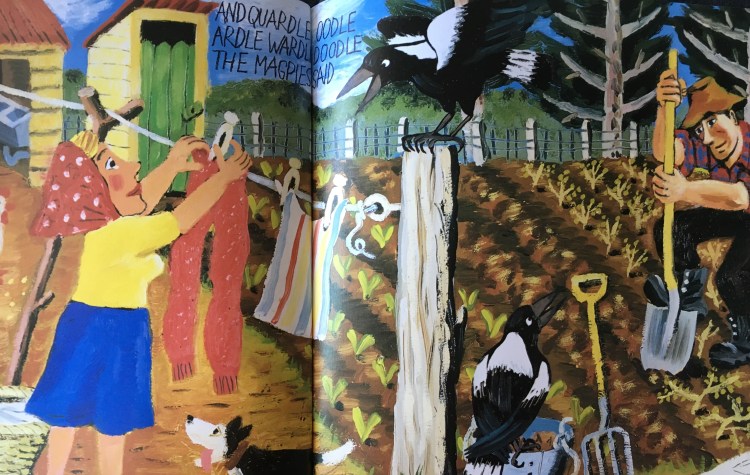
and Quardle oodle ardle wardle doodle


The magpies said

The magpies sing their song in the centre of the doublespread looking at both Elizabeth and Tom. Elizabeth is pinning up Tom’s longjohns, with the essential long-drop in the background. There are no frills in her life: her scarf is not ornament but essential head covering in their cool shaded patch, nevertheless it is red to match her lips. Tom works the soil at the right, doggedly digging out spiny weeds to replace with soft greens. His crooked shovel and the tall and inedible pines behind hint at the futility of this task if the mapgies’ laughing cry isn’t enough. The uncredited book’s designer created half-pages so that their presence and mocking refrain is revealed after each verse.

The painter Dick Frizzell is famous for his sardonic visual commenting on Kiwiana but there’s only tenderness in his portraits here, and the hand-lettered text by Denis Glover is a sparse love poem. Elizabeth and Tom are shown in their prime working against the odds to make a life for themselves against the relentlessness of a mortgage. In another New Zealand classic Man Alone by John Mulgan, he describes a similar farm : They milked the cows by hand and if there was any cash from sales it went back into the farm, which was covered with fern and blackberry, and looked ready to swallow any amount of money.

Do check out the Paul Kelly performance of the poem as a song – Australia too has its bush blockies and battlers.

Many poems and song lyrics intended for adults made their way into picturebook texts, especially during the 1970s. (Quentin Hole‘s interpretation of Banjo Paterson’s The Man from Ironbark got me right in the jugular at the time.)

By now, the close reader of this blog has spotted my fudging of my own rules. This book was reissued in this edition in 1999, so that wasn’t when I first encountered it. And neither of my children showed enthusiasm over it at that time either.

Did you know that I was born in Aotearoa?

Anne Lamott explains that ‘your parents came with siblings who adored you because you were not theirs.’ My Kiwi relatives had to do without me completely when we came to Australia when I was 9, but they wrote to me – birthday cards and letters and the occasional baffling but book-handy postal order.

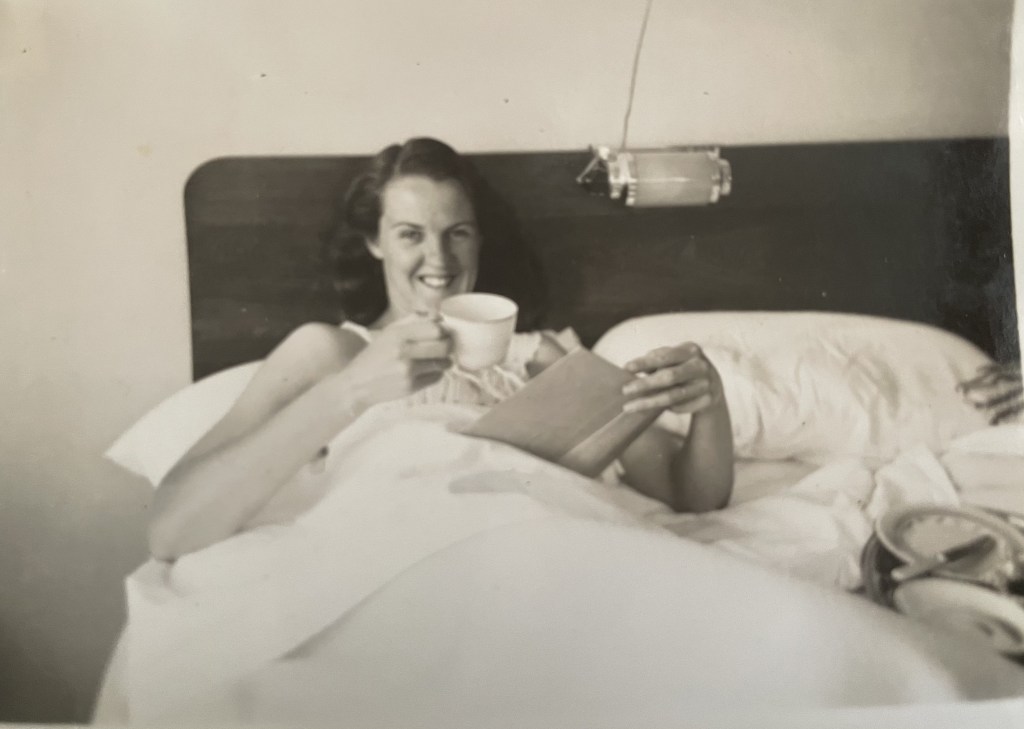
May Robson, nee Kemp, was married to my father’s older brother Ken. This photo was taken on one of their early trips together. Eventually Ken’s work with a multinational company enabled them to travel to Australia and beyond, and in the early 1980s I saw her frequently.

May was Froebel trained and taught young people with disabilities. She talked with me about books that she used in the classroom. Her observations of one of her young students obsessed with Dean Hay’s I Can Tell the Time was curiously prescient about Big Bob.

She was a great reader, and interested in children’s books, and loved visiting the libraries where I worked.  I was also gifted contemporary picturebooks from New Zealand, which I was very grateful for, but this one came too late into my life to find out what she thought – she passed away in early 1999.

I visit the remnants of her collection today in the house of my favourite cousin, but it’s not the same.

The Bush Jumper 1998

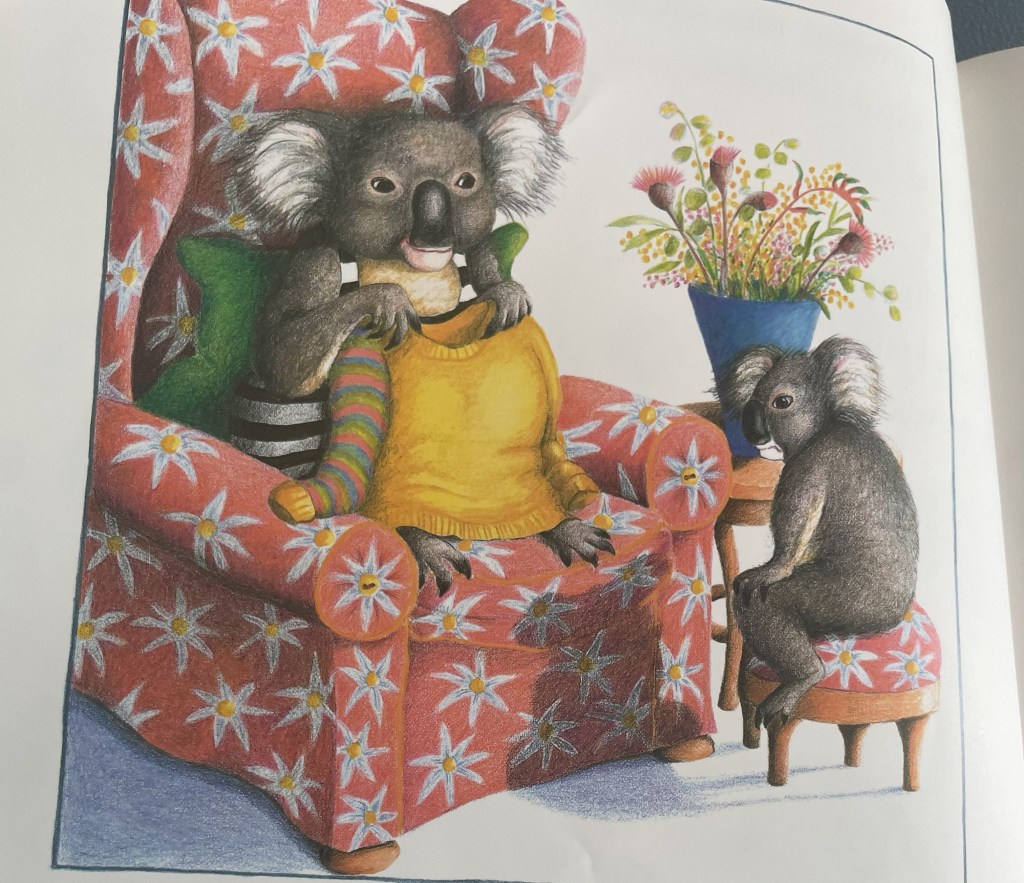
“This is a bushland jumper, Mitti. Yellow for wattle blossom, green for gum leaves, pink for boronia flowers and blue for summer skies.”

Mitti stared at the striped sleeve. It was horrible! But she couldn’t tell her mum that, not when she had knitted and knitted all day long.

“Thank you, Mum,” Mitti said.

Mitti’s awkward pose on the footstool shows her mixed feelings for the garment Koala is proferring. Ali Beck illustrates clearly that the jumper, which Mitti had requested to be all ‘yellowy-yellow’ is too large for her : its size more suited to a wombat, receives her small shadow like an omen. The hated sleeve is obviously much too long.

Marsupials sitting on furniture never really convinces, but the buttoned flannel flowers on the arms of the chair demonstrate that Koala not afraid of using any needle for decoration.  The ‘southern skies’ blue vase full of native flowers are a perfect match for the colours of the odd sleeve, with the kangaroo paw arching in sympathy to meet Mitti’s dejection. The whole picture floats in an interior left blank for the reader’s imagination, and so that Mitti’s feelings are front and centre.

Jean Chapman was a prolific writer for children. As a scriptwriter for Kindergarten of the Air, she wrote simple stories that were developmentally perfect fit for the under 5s. Many of these were published in the 1970s in collections like Tell Me a Tale, joyously illustrated by Deborah and Kilmeny Niland. I used them as rich material for the early years of preschool storytime progamming, and we read them together as a family.

To clothe or not to clothe bush animals is a dilemma for quite a few spinners of Australian yarns. By making Mitti this jumper, what does Koala herself hope to achieve? Perhaps redemption for the weird swimming-costume/butcher-apron that she herself wears.  (Mitti’s bush playmates wear no clothing, but if they did, there would be no plot.) In the best tradition of stories for the 3-5 year old, self-determination meets potential disaster, which is narrowly averted. Another of Koala’s housekeeping competencies restores things to their natural order, without reproach, and the jumper’s sleeve becomes ‘zingy-zing zing!’

For my readers outside of Oz, here’s some fun discussion about the nomenclature of woollen garments.

Ms May says that she loved returning to this book again and again. She was the victim of an enthusiastic needle-wielding mother herself.

My garment sewing skills were basic. I did a Kwik Sew course in the 1980s, fired up the overlocker, and I loved experimenting with the vibrant children’s prints on offer at Aherns department store in Rockingham.

Like Koala, I made do with whatever ribbing I had to hand to finish garments – if challenged, I could say that it was meant to be “contrasting” but MM always knew the truth. Here she is, gamely smiling her way to kindergarten in 1998, and dreaming of store-bought school uniforms.

It wasn’t my first offence. I was a knitter from childhood, and saved this pattern from the English Woman’s Weekly for years before Big Bob was even thought of.  Here he is, not mentioning the colour change of the neckline and cuffs.

This wonderful picture book spoke to us all in its own way.

Big Bob and Books 1997

Generally between 18 and 24 months of age, hyperlexic children demonstrate their ability to identify letters and numbers. Quite often by three years of age, they see letters grouped as words and begin to read them. It does not matter in what context the words appear: the child will recognise them whether typed or handwritten, upper case or lower case. Very likely, the hyperlexic child’s speech has not developed normally at this point in time, and he or she is reading words or phrases before mastering spoken language used by other children of the same age.

This is not a skill that is taught. The reading simply begins one day and does not stop. The recognition of words progresses to sounding out printed words – without phonetic instruction. The child learns to “decode” words. Some hyperlexic children achieve a very fluent level of instant, visual decoding and seldom mispronounce even difficult words. Other children continue to recognise words by size or shape, or use a combination of phonetic decoding and sight recognition.

I relied on self-directed reading from early on in my career to try understanding of how children learned to read, but I never received any formal pedagogical instruction.

As I related in a previous blog post Goodnight Moon was a favourite of Big Bob’s from birth. As a three-year-old, he and a pre-walking Ms May would be in the family room with me as I sorted fabrics or wool.  He often paged through picture books on the floor or a low table while I half-squinted in his direction, and recited their texts. One day I stumbled on And two little kittens / and a pair of mittens / and a quiet old lady whispering Hush.  Big Bob raised his head and stared at me, looked back at the page, and then back at me.  I remember wondering if he was reading the words and then dismissing it as nonsense. He was still waiting. And two little kittens / and a pair of mittens / and a little toyhouse / and a young mouse.

During 1997, Big Bob experienced his first year of schooling We were all fortunate that his diagnosis guided us to excellent educators who understood his strengths and worked with them. He would read the fine print (‘For Teachers’) on the bottom of worksheets and do as it said. It was one of those fine women who recommended Reading Too Soon.

When I left Kids’ Own Publishing in 2022, they gave me this superb tribute created by Bern Emmerichs which documents my weakness for game shows : and it’s a shared pleasure with adult Big Bob: and he’s a gun on Wordle. I like to think that Margaret Wise Brown contributed just a little to his extensive vocabulary.

Back to picture books, in 1998.

The Story of Little Babaji 1996

And Little Babaji said, “Oh! Please Mr Tiger don’t eat me up, and I’ll give you my beautiful little purple shoes with crimson soles and crimson linings.”

But the Tiger said, “What would your shoes be to me? I’ve got four feet, and you’ve got only two. You haven’t got enough shoes for me.”

But Little Babaji said, “You could wear them on your ears.”

“So I could,” said the Tiger, “that’s a very good idea. Give them to me, and I won’t eat you this time.”

More than twice Babaji’s height and weight, the Tiger considers the proposed shoe-for-boy swap like the sleek and elegant creature he is.  His identical and equally fashion-conscious brothers have already fallen for this proposed bargain, but he may prefer the meal.  The magnificent painted stripes show off the sinuous, but dubious, posture but the front legs are folded on a belly which is obviously not hungry.  Little Babaji has no protection except the umbrella, posed shield-like – surely that silk will be slashed to ribbons by a great paw? – even down to his underwear, he retains his bargaining power, and his life.

It’s a jewel of a book, with pages like handmade paper to the touch. Author Helen Bannerman takes the theme of ‘eat or be eaten’ to new levels in her story created for her own children and originally published as Little Black Sambo. (Her paintings are best described as amateur watercolours; like Potter, she did not excel at human faces.) Fred Marcellino worked as a designer and illustrator in many forms before he segued into picture books. The overall design of this book references the tiny original, but as a square like the album covers he also designed, it’s easy for small hands to hold while he and Ms May and I snuggled together.

After years of customer service in public libraries, in these early years of family life I literally worked the other side of the counter. Through a small branch library in a park near our property, Western Australia’s state-based public library system ensured that if a book I wanted was on a shelf 2000 km away, I had only to ask for it and it appeared a ridiculously short time later. (It didn’t apply to children’s books so I didn’t come close to abusing it.) I still had dear friends in the US to send me books I’d otherwise not see, like this one that Amy gave us.

Apart from kidding myself that we had enough good books in our home to satisfy all of our picturebook sharing time, Big Bob’s borrowing choices were always interesting. He selected one that became a huge favourite with him: Don and Audrey Wood’s Twenty Four Robbers and it became that book that we had to buy.  It was not hard to see its appeal – numbers AND eating.  Like Little Babaji, he would have no trouble eating 169 pancakes in a session.

His speech was still almost entirely limited to these topics at age 3-and-a-half, and he cowered, as if tigers were roaring, when exposed to any kind of loud noise. Here he is, enjoying a morning read of the stock prices.

His diagnosis of autism tore the stuffing out of the family, for a time. Now, read on …

Math Curse 1995

THE WHOLE morning is one problem after another.

There are 24 kids in my class.

I just know someone is going to bring in cupcakes to share.

Jake scratches his paper with one finger.

How many fingers are in our class?

Casey pulls Eric’s ear.

How many ears are in our class?

The new girl, Kelly, sticks out her tongue at me.

How many tongues in our class?

I’M about to really lose it, when the lunch bell rings.

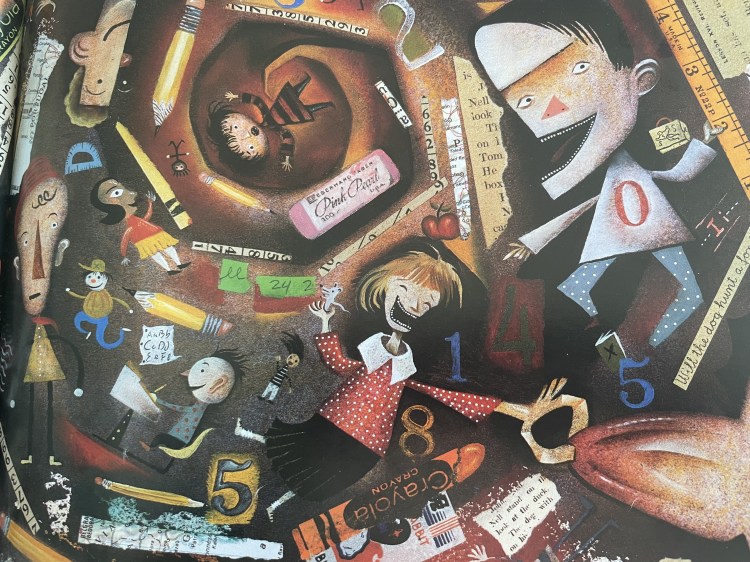
Jon Scieszka uses the vernacular of an eight-year-old caught in a nightmare of his own devising, brought on by taking his teacher’s advice : YOU KNOW, you can think of almost everything as a math problem.

Illustrator and designer team Lane Smith and Molly Leach show the increasingly zany possibilities of this instruction, until the narrator rescues himself (with fractions!) to find that a little arithmetic can, in fact, be useful.

At first glance, this page borrows heavily from the Walter Wick I Spy titles which were popular in this same decade with Big Bob and Ms May and at least forty million other children. But look closer. The narrator swirls in a vortex of pencils, paper scraps, grotesque child figures and numbers, numbers, numbers. The suffused background is the perfect background for the chaos, with chalk marks to ground it in Ms Fibonacci’s classroom : is that her in the yellow skirt reaching out a helping hand? The more you look, the more you see : even now, after thirty years of reading it, I’m discovering new layers.

Prolific children’s writer Adam Rex has described his encounter with Scieska and Lane’s work as a child : These books (and others) showed me that below the dollhouse of children’s literature there was a semi-furnished basement where people drew funny pictures and tried to crack each other up, and that there was maybe a space free on their orange, beer-stained sofa.

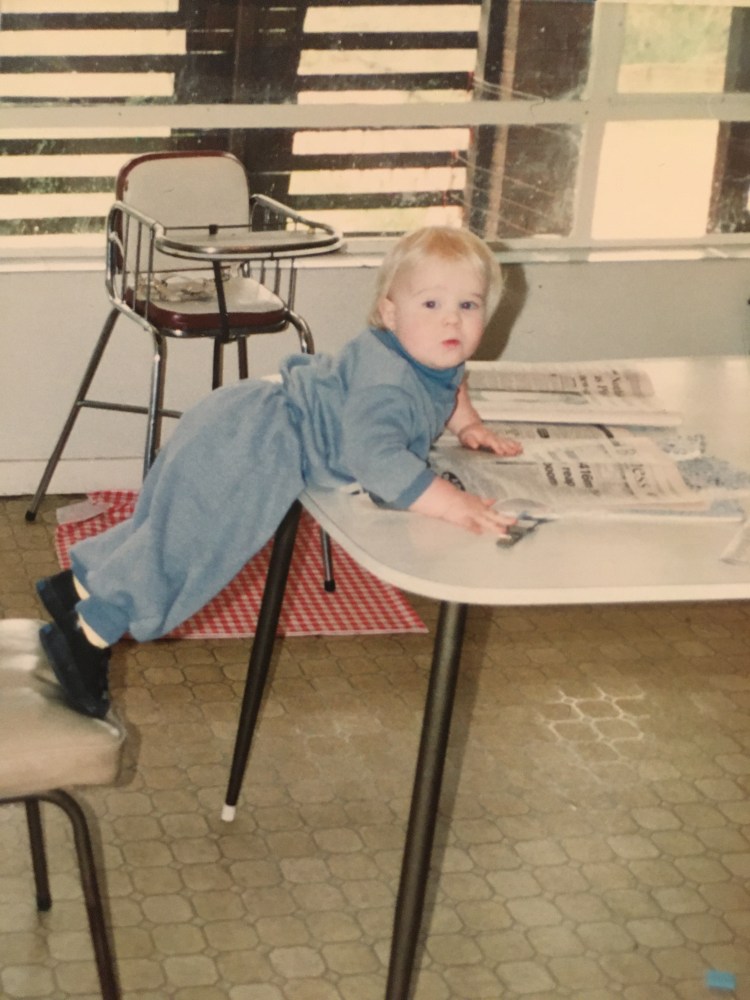
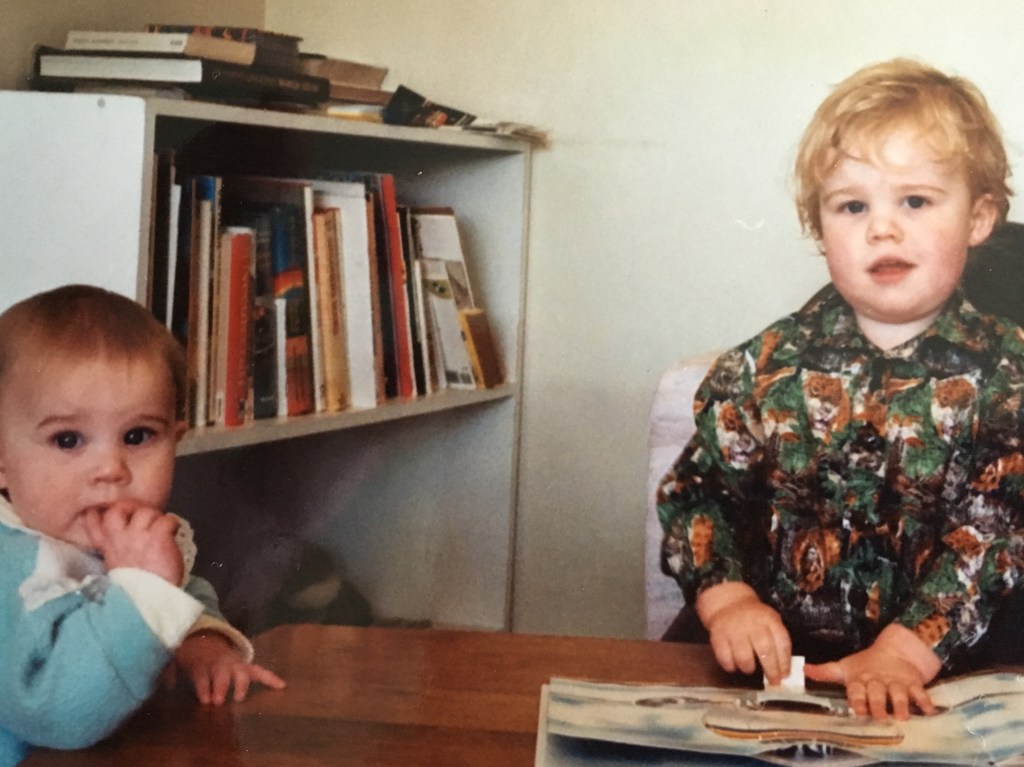
With a mathematician for a father, it made sense that toddler Big Bob noticed numbers everywhere, and could read them aloud from toddlerhood. Here he is with his sister, pulling on the tab of a book I don’t recognise. (Sorry, Safety Bay library.) She’s wondering if she’ll be helping her mother add up forever. (She will.)

He was my first child – I thought it was just interesting that his first word was clock and not Mum.

My little cupcakes loved this book with its cherry classmates, and I’m sure it influenced their futures. Big Bob is a financial analyst in a government department who loves sweets, and Ms May can whip up a spreadsheet as well as precisely calculated quilts.

The Dumb Bunnies 1994

Once upon a time there were three dumb bunnies who lived in a log cabin made out of bricks.

A cover note on this Scholastic edition by Kirkus Review says, ‘Let’s not elevate this by calling it wit.’

The Great Green Room retains its original folded blanket, the bowl full of mush and a lady knitting. The addition of twin lava lamps and flippers for Baby Bunny to go ice skating under the lake are a great invitation for the reader to start giggling. and Dav Pilkey’s rabbits gaze out at the reader, full of the self-satisfied knowledge that what their family does is always right.

Pilkey acknowledged his source with Special thanks to Thacher Hurd and the folks at HarperCollins for letting the Dumb Bunnies spend the night in the Good Night Moon Room.

Big Bob beams from his new home in Perth, Western Australia. We made the move west in early 1994, and by year’s end he would have a new baby sister. But for now I had baby and bookshelf settled. His grin seems to say, You’re never going to read that 3 volume Shelby Foote history of the Civil War! and he was right.

When I first thought of writing this blog, I was going to select and write about all my favourite picture books. A word that is (as it turns out) very unhelpful when choosing books to write about. How was I to create a manageable and achievable list out of favourite…what?  Favourite books by illustrators I revered; favourite ones with green covers; favourite obscure titles where I could really show off?

In the end, I decided on the restriction that the book for each year between 1977 – 2017 would have to have been first published in that year.  Unfortunately this eliminated Goodnight Moon, even though Big Bob and I enjoyed it together at least once daily, from birth until he was toddling, when Peepo! took over.

I hadn’t know that this classic book – first published in 1947 –  existed before I went to the US.  (Although other American titles were listed in Babies Need Books, this one wasn’t, a rare omission by Dorothy Butler.) I fell in love with it there as a storytime staple, and my children were stuck with it.

I have a visceral loathing for other parodies such as Go the F*ck to Sleep and have trained myself to look neither right nor left of bookstore registers in case I see one.

However, in the following years Big Bob and Ms May were well-primed to love the Dumb Bunnies’ plays on words, and their complete contradiction in pictures that Pilkey produced. When the animated series was shown on TV, their enjoyment was complete.

In late 1994 the newest member of our family was getting Goodnight Mooned, whether she liked it or not.