Year in year out they worked
while the pines grew overhead
and Quardle oodle ardle wardle doodle
The magpies said
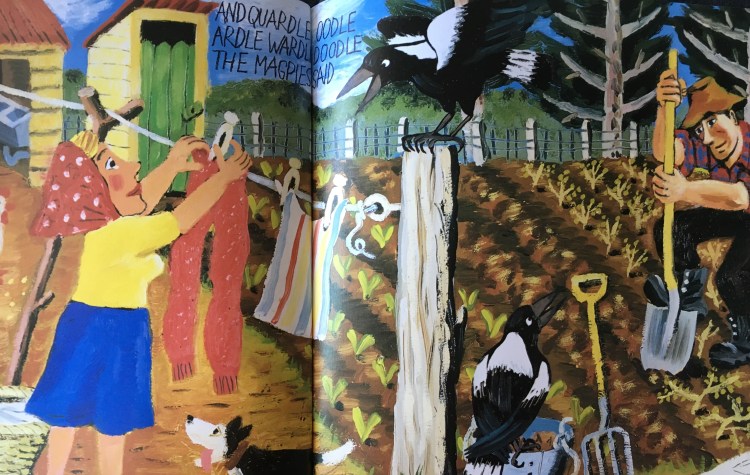
The magpies sing their song in the centre of the doublespread looking at both Elizabeth and Tom. Elizabeth is pinning up Tom’s longjohns, with the essential long-drop in the background. There are no frills in her life: her scarf is not ornament but essential head covering in their cool shaded patch, nevertheless it is red to match her lips. Tom works the soil at the right, doggedly digging out spiny weeds to replace with soft greens. His crooked shovel and the tall and inedible pines behind hint at the futility of this task if the mapgies’ laughing cry isn’t enough. The uncredited book’s designer created half-pages so that their presence and mocking refrain is revealed after each verse.
The painter Dick Frizzell is famous for his sardonic visual commenting on Kiwiana but there’s only tenderness in his portraits here, and the hand-lettered text by Denis Glover is a sparse love poem. Elizabeth and Tom are shown in their prime working against the odds to make a life for themselves against the relentlessness of a mortgage. In another New Zealand classic Man Alone by John Mulgan, he describes a similar farm : They milked the cows by hand and if there was any cash from sales it went back into the farm, which was covered with fern and blackberry, and looked ready to swallow any amount of money.
Do check out the Paul Kelly performance of the poem as a song – Australia too has its bush blockies and battlers.
Many poems and song lyrics intended for adults made their way into picturebook texts, especially during the 1970s. (Quentin Hole‘s interpretation of Banjo Paterson’s The Man from Ironbark got me right in the jugular at the time.)
By now, the close reader of this blog has spotted my fudging of my own rules. This book was reissued in this edition in 1999, so that wasn’t when I first encountered it. And neither of my children showed enthusiasm over it at that time either.
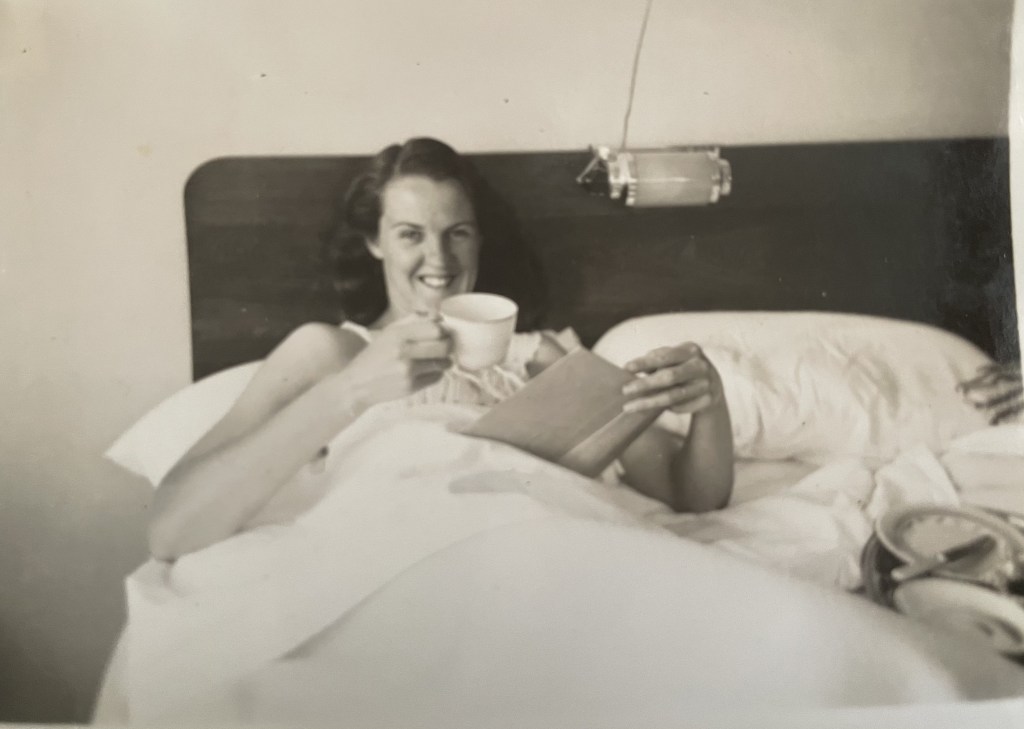
Did you know that I was born in Aotearoa?
Anne Lamott explains that ‘your parents came with siblings who adored you because you were not theirs.’ My Kiwi relatives had to do without me completely when we came to Australia when I was 9, but they wrote to me – birthday cards and letters and the occasional baffling but book-handy postal order.
May Robson, nee Kemp, was married to my father’s older brother Ken. This photo was taken on one of their early trips together. Eventually Ken’s work with a multinational company enabled them to travel to Australia and beyond, and in the early 1980s I saw her frequently.
May was Froebel trained and taught young people with disabilities. She talked with me about books that she used in the classroom. Her observations of one of her young students obsessed with Dean Hay’s I Can Tell the Time was curiously prescient about Big Bob.
She was a great reader, and interested in children’s books, and loved visiting the libraries where I worked. I was also gifted contemporary picturebooks from New Zealand, which I was very grateful for, but this one came too late into my life to find out what she thought – she passed away in early 1999.
I visit the remnants of her collection today in the house of my favourite cousin, but it’s not the same.

 40 Years of Picture Books
Morning! Just wanted to request you please swopping my ema
LikeLike
Love the photo!Sent from my iPad
LikeLike