And Little Babaji said, “Oh! Please Mr Tiger don’t eat me up, and I’ll give you my beautiful little purple shoes with crimson soles and crimson linings.”
But the Tiger said, “What would your shoes be to me? I’ve got four feet, and you’ve got only two. You haven’t got enough shoes for me.”
But Little Babaji said, “You could wear them on your ears.”
“So I could,” said the Tiger, “that’s a very good idea. Give them to me, and I won’t eat you this time.”

More than twice Babaji’s height and weight, the Tiger considers the proposed shoe-for-boy swap like the sleek and elegant creature he is. His identical and equally fashion-conscious brothers have already fallen for this proposed bargain, but he may prefer the meal. The magnificent painted stripes show off the sinuous, but dubious, posture but the front legs are folded on a belly which is obviously not hungry. Little Babaji has no protection except the umbrella, posed shield-like – surely that silk will be slashed to ribbons by a great paw? – even down to his underwear, he retains his bargaining power, and his life.
It’s a jewel of a book, with pages like handmade paper to the touch. Author Helen Bannerman takes the theme of ‘eat or be eaten’ to new levels in her story created for her own children and originally published as Little Black Sambo. (Her paintings are best described as amateur watercolours; like Potter, she did not excel at human faces.) Fred Marcellino worked as a designer and illustrator in many forms before he segued into picture books. The overall design of this book references the tiny original, but as a square like the album covers he also designed, it’s easy for small hands to hold while he and Ms May and I snuggled together.
After years of customer service in public libraries, in these early years of family life I literally worked the other side of the counter. Through a small branch library in a park near our property, Western Australia’s state-based public library system ensured that if a book I wanted was on a shelf 2000 km away, I had only to ask for it and it appeared a ridiculously short time later. (It didn’t apply to children’s books so I didn’t come close to abusing it.) I still had dear friends in the US to send me books I’d otherwise not see, like this one that Amy gave us.
Apart from kidding myself that we had enough good books in our home to satisfy all of our picturebook sharing time, Big Bob’s borrowing choices were always interesting. He selected one that became a huge favourite with him: Don and Audrey Wood’s Twenty Four Robbers and it became that book that we had to buy. It was not hard to see its appeal – numbers AND eating. Like Little Babaji, he would have no trouble eating 169 pancakes in a session.
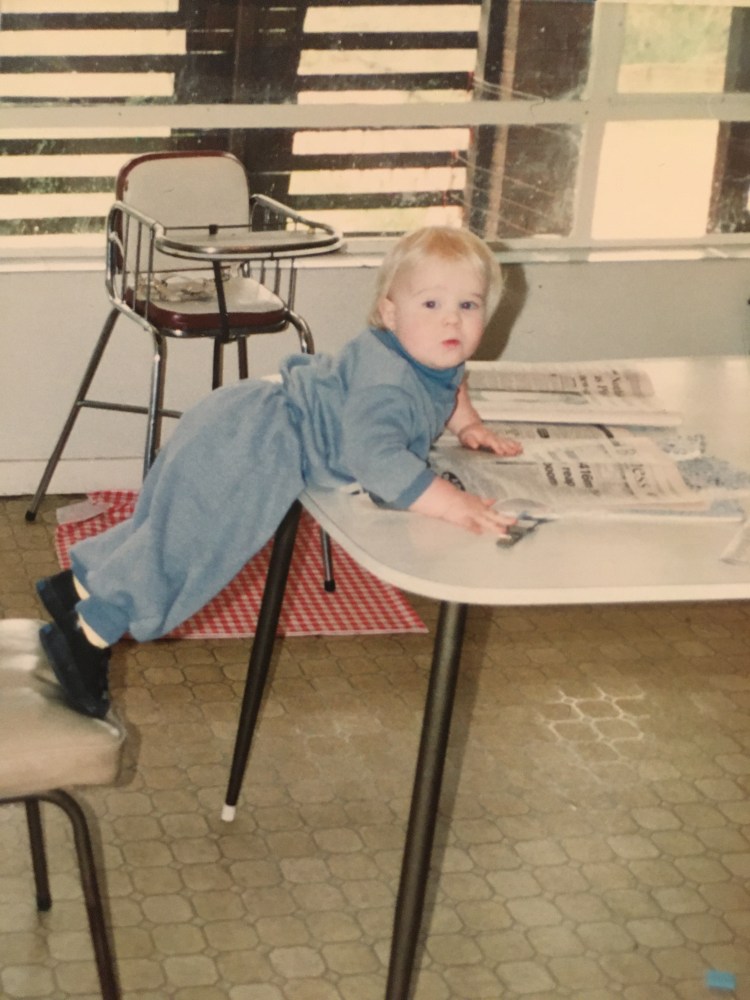
His speech was still almost entirely limited to these topics at age 3-and-a-half, and he cowered, as if tigers were roaring, when exposed to any kind of loud noise. Here he is, enjoying a morning read of the stock prices.
His diagnosis of autism tore the stuffing out of the family, for a time. Now, read on …
 40 Years of Picture Books