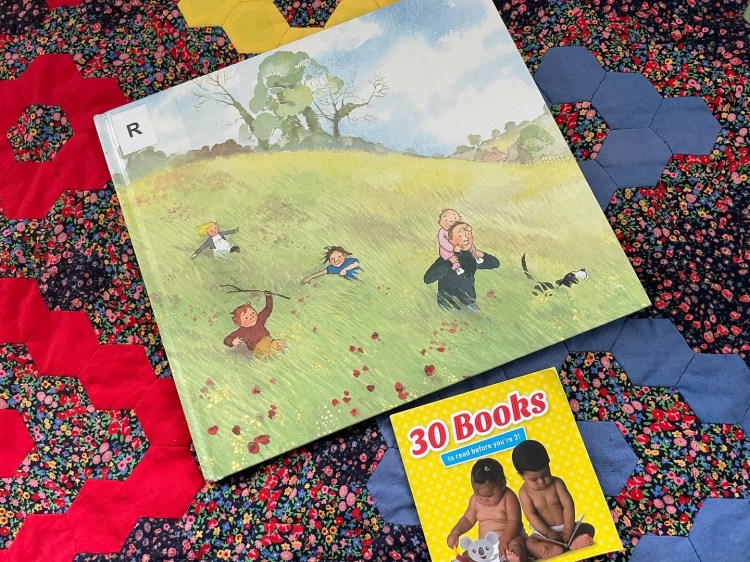
Uh-uh! Grass!
Long wavy grass.
We can’t go over it.
We can’t go under it.
Oh no!
We’ve got to go through it!

Helen Oxenbury’s family doesn’t falter as they go through all of the obstacle on their bear hunt. Father carries, cajoles, shelters and protects each child individually as needed. The baby, as we might expect from this artist, is no burden but an active player – cared for at key moments by each family member in turn. The small reader is rollicked along by Rosen’s text, as fast or as slow as their reading adult likes. (Here’s his own reading.) The wordless end to the story is perfect: the poor bear shambles back along a Norfolk beach, waiting for the next time a careless bunch of humans accidentally routs him out. Fortunately for them, bedcovers are the best defence against tooth and claw.
Before leaving Australia in autumn 1988, I applied for a small Library Association of Australia travel grant to enable me to observe innovative programs for children under 5 and their parents. Fairfax County hosted many storytimes and toddler times, and I was inspired by observing the varied presentation styles of my colleagues.
The travel grant gave me the funds to spend time in Baltimore and surrounds. Carol Roberts, librarian-storyteller extraordinaire, took me with her as she visited children being cared for by family day caregivers in homes. That was a day that demonstrated the value of relationship building and story sharing that I have never forgotten, and the friendship forged still warms me. I also visited Enoch Pratt Free Library and briefly envied its wood panelled children’s room and inbuilt fish pond with a fountain; before I saw that they used a classification system completely unlike Dewey’s. I would have been lost, so thank goodness Donna had gone to Fairfax County. Their stacks were identical to the ones in Ghostbusters. There was enough money left for a return train trip to New York to see the inspirational work of Hannah Nuba Scheffler at the Hudson Park Library. It was the home of the Early Childhood Resource and Information Center and the prototype for practices and programs that are well established three decades later. I thought of Hannah and her team when I toured City of Melbourne’s recently opened narrm ngarrgu.
Central to all of this programming was the selection and sharing of terrific picturebooks for toddlers and preschoolers and I still clung tightly to Dorothy Butler’s Babies Need Books as my guide. At the very end of my exchange year, in the spring of 1989, New York Public Library hosted a one day seminar on the importance of the early years, with DB herself as a keynote speaker. I couldn’t miss it. Another FCPL children’s librarian, Jackie Gropman, was also going. She suggested we meet for dinner beforehand, and we haven’t stopped talking children’s books since. In a letter to my mum, I said “It was wonderful and a fitting end to my year here, being a gathering of people who think the same way I do.”

Other bear books have captured my heart – Michael Hague’s wistful slumping ted was licensed as a poster by FCPL this same year – but Oxenbury’s is one of the best. Versions of the book since then are indicative of the ways in which story sharing in public library spaces have evolved : it’s now both a board book and a Big Book.
Back in Ballarat, I began to hunt for pastures new myself – swishy swashy, swishy swashy, swishy swashy.
 40 Years of Picture Books