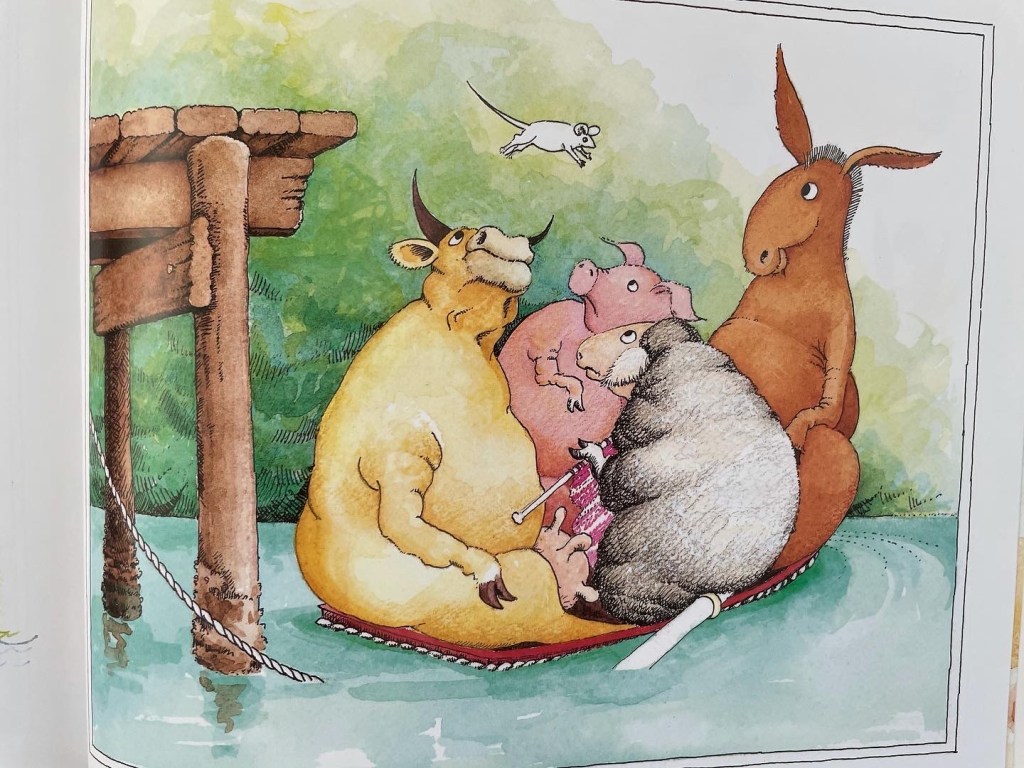
Was it the little mouse,
the last to get in,
who was lightest of all?
Could it be him?
The toddler – as picture reader and listener – knows that the climax of the story is coming, and their delight in the triumph of the smallest creature will be complete. Allen has drawn all eyes on the mouse, guiding the reader to do the same. Those already afloat regard his launch from the jetty with different expressions : the sheep is doubtful she will finish her row, the cow sanguine in her splayed helplessness next to the pig’s pessimism that fat-shaming will get her the blame. Look at the eye contact between donkey and mouse. The donkey has kept up a cheerful smile, occasionally breaking into a braying laugh, throughout the action. Now she and the mouse lock eyes in their joint knowledge of the coming catastrophe.
Years after enjoying this book from birth, Ms May shared it when she was a Year 6 ‘buddy’ to children just starting school. She made them laugh by pointing to the sad soggy parade of characters on the last page – one by one -saying, “Wet, wet, wet, wet, DRY!”
Dorothy Butler wrote, in Babies Need Books :
[T]here is a definite gap, at the time of writing, in the ranks of fiction for the two-to-three year olds. Its form, certainly, is a demanding one, requiring as it does the provision of characters who come alive in situations which are believable, and action which happens – all within the experience or imagination of a human being whose knowledge of the world and its ways is only just beginning to widen.
Two years later after Butler wrote these words, this book was published by an author-illustrator who has done much to fill that gap. Who Sank the Boat? became THE perfect book for the newest library trend: Preschool Storytimes. Previously, the only library programming was during the school holidays – craft activities; showing films; and puppet shows. With great trepidation, I began weekly storytimes for under fives and their parents and carers.
The book opens with an aerial view of Mr Peffer’s place, unmistakeable as an Antipodean beach house. The text in verse is the perfect length and rhythm for the intended audience and had that essential element – a question that a small person could answer with supreme confidence after the first reading. The tension of the cumulative action though always leaves room for a shred of doubt. Maybe it was the cow.
Allen’s sensitivity to how a small child learns to read pictures is on full display here. The left hand page with text and action in miniature – sometimes in sepia crosshatched sketch – leading to the full colour right hand page to be pored over. Her earlier book, Mr Archimedes’ Bath employed similar themes of water displacement with the same device.
‘An instantaneous visual and verbal delight’ was the verdict of all seven judges of the Children’s Book Council of Australia when awarding Picture Book of the Year award to Who Sank the Boat in 1983 – the first of many accolades for her work, including the Margaret Mahy medal in 2004.
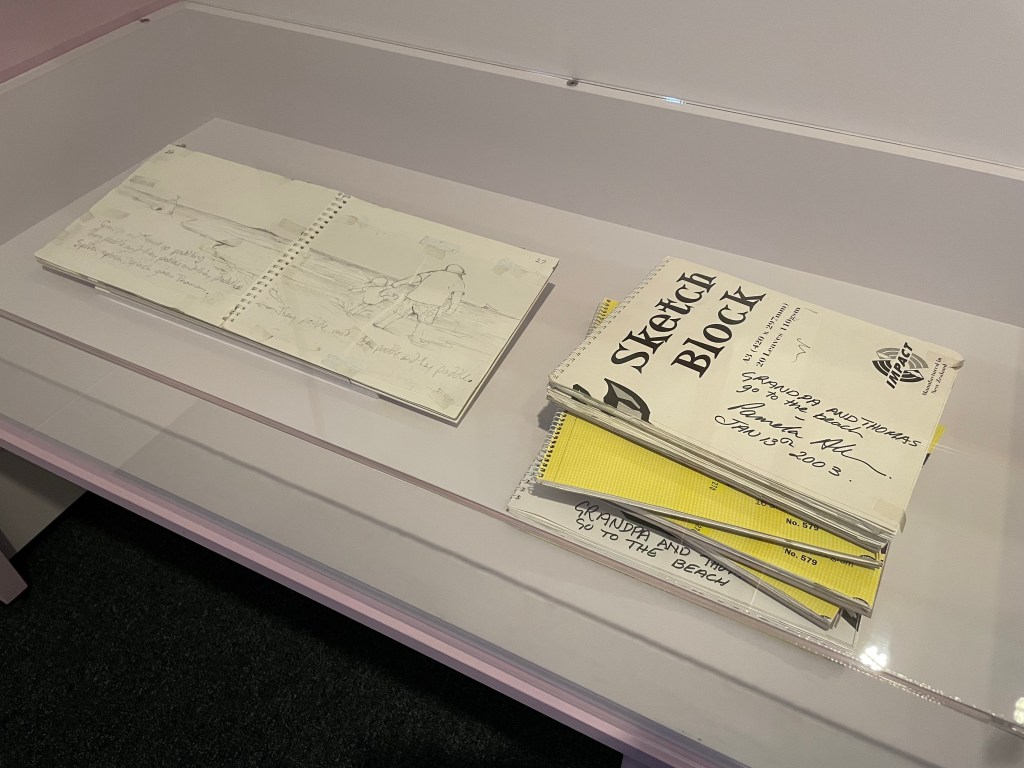
Allen recently gifted her sketchbooks, roughs and finished work to the State Library of New South Wales, where they are currently (literally) showcased as part of the Imagine… the Wonder of Picture Books exhibition until July 2023.
Portions of this blog were previously published in an article in Magpies magazine.
 40 Years of Picture Books